 Diastra
 Zone 2 and Easy · Part 3 of 5
Why is Zone 2 running so slow that I have to walk?
Zone 2 often feels too slow because many charts end it at 70% of a max heart rate guessed from your age. Blood tests on recreational runners found easy running ends at 78.9% of max for the average man and 83.6% for the average woman.
On this page
- Why does Zone 2 make you walk?
- Where does easy running end?
- Is your max heart rate a guess?
- Why do heat, hills and long runs push you over?
- Could your fitness be the reason?
- What should you do when Zone 2 makes you walk?
- When is slow the right speed?
- How does Diastra draw your Easy band?
- More questions
- Sources
Why does Zone 2 make you walk?
You head out for an easy run. Your watch says Zone 3 a few minutes later. You slow down, and it still says Zone 3. So you walk, and you wonder how slow easy running is supposed to be.
Several things can put you over a Zone 2 line. The chart may start from a max heart rate guessed from your age. The chart may also end Zone 2 below the point where easy running ends for the average runner. Heat, hills and long runs raise your heart rate at the same pace. And your fitness sets where your easy effort ends today.
Start with your own numbers. Enter your age and sex, and add your max heart rate if you know it.
Find your heart rate zones
Type your age. Add your sex and a max you have seen if you know them. The example below is a 35-year-old.
Age 35 · max heart rate 208 − 0.7 × 35 = 184, an estimate
Your Easy band, your Zone 2111 to 146beats a minute
Your Easy band runs 16 beats higher than the common Zone 2 chart lets you go.
Max from age uses Tanaka’s formula (208 − 0.7 × age). Easy ends where blood tests find lactate starting to rise, which is higher for women than for men. What you type stays on this page.
Diastra reads your max from your own Apple Watch workouts or a guided test and draws your bands from it.
Start my free trialWhere does easy running end?
Easy running ends at your first lactate threshold. That is the point where lactate starts to rise in your blood above its resting level. Lactate is a fuel your muscles make, and it builds up faster as the effort climbs.
Finnish researchers measured this line with blood tests on 165 recreational runners. The first threshold came at 80.7% of max heart rate on average. It came at 78.9% of max for men and 83.6% for women[1].
Many Zone 2 charts stop at 70% of max. Take a max of 180 beats a minute. Seventy percent of 180 is 126. The study's averages land at 142 for men and 150 for women. That leaves 16 to 24 beats a minute between the chart's line and the point where easy running ended for the average runner.
The averages hide a wide spread. Forty-three of every 100 runners in the study were already past their first threshold at 80% of max[1]. A lab study of 100 adults found the first threshold anywhere from 60 to 90% of max[2].
A fixed percentage cannot find one person's line. It missed the first threshold by about 7 beats a minute on average, even with each runner's measured max[1]. That was a best case, because the study took its percentages from the same runners it tested. A chart line is a starting estimate for your threshold. Your breathing and your effort fill in the rest.
Is your max heart rate a guess?
Every line on a Zone 2 chart is a percentage of a max heart rate. Many charts and watches work one out from your age when you have never measured your max. A common research formula is 208 minus 0.7 times your age[3]. That formula gives 180 for a 40-year-old.
An age formula gives the middle of a crowd. Max heart rate differs a lot from one runner to the next. Measured max heart rate in the runner study averaged 188 beats a minute, give or take about 8[1]. The researchers also swapped in the age formula for each runner's max. The average miss at the first threshold grew from about 7 beats a minute to about 9[1].
A max that is too low pulls every line down with it. Say your real max is 190 and the chart uses 180. The 70% line drops from 133 to 126. That puts the line 7 beats too low.
The max heart rate formulas page compares the common age formulas. Finding your max on Apple Watch shows how to measure yours.
Why do heat, hills and long runs push you over?
Heat makes your heart rate climb more at the same pace. Ten trained men in one study cycled at one steady, moderate effort in a hot room and again in a cool room. The hot room was 95°F, and the cool room was about 72°F. Their heart rate rose 11% between minute 15 and minute 45 in the hot room. It rose only 2% in the cool room[4]. The blood pumped with each beat fell by 11% in the heat[4].
A second heat study shows how far that climb can go. Nine cyclists held one steady effort in a 95°F room. Their heart rate climbed from 151 to 169 beats a minute over the same half hour[5].
Hills take more work. Running uphill takes more energy for every meter you cover. A steeper slope takes even more[6]. Heart rate climbs in step with the oxygen your body uses[7]. So a hill can raise your heart rate even when your pace drops. On the steepest slope in the study, walking took a little less energy than running[6]. Walking the steep parts helps keep the effort easy.
Long runs add heart rate drift. Drift is a slow climb in heart rate while your pace stays the same. In the second heat study, heart rate kept climbing for the whole half hour[5]. A long run gives drift more time.
Drift shows up at harder paces too. Fifteen young trained runners in one study held one fairly hard speed for 40 minutes. Their heart rate rose by about 4% of max on average. One runner's rose by 8%[8]. The speed never changed.
So a pace that starts under your Zone 2 line on a hot day can cross it later in the run. Your heart rate moved, and the chart stayed still.
Could your fitness be the reason?
Sometimes slow is where your easy effort is today. The lab study of 100 adults found first thresholds as low as 60% of max[2]. Some people reach their first threshold early, and a slow jog or a brisk walk is their easy effort for now.
Easy training can improve your easy efforts over time. A 10-week study put 35 untrained adults on exercise bikes. One group rode easy at 63% of max for about 6.7 hours a week. The other group trained hard for about 1.6 hours a week. Only the easy group showed a clear gain in low-intensity performance. That measure included the first lactate threshold. Only the hard group showed a clear gain in high-intensity performance[12].
Each kind of training improved its own kind of effort in that study. This fits the way many runners mix lots of easy running with a little hard running. 80/20 running explains the mix.
What should you do when Zone 2 makes you walk?
Walk when you need to
Walk breaks are fine. Walk until your heart rate settles back into your Easy band, then jog again. Walk the steep hills too. A run with walk breaks is still an easy run when your heart rate stays easy.
Slow down by feel
Effort is a steady guide on days when heart rate is not. Researchers looked at 863 lab tests. People of every fitness level rated the first breathing threshold at about 12.5 on the 6 to 20 effort scale[9]. That threshold is the point where your breathing first picks up. The runner study found the same 12.5 at the first lactate threshold[1]. A rating of 12.5 falls between light and somewhat hard. Stay below that feeling on an easy run.
The talk test works anywhere. A study of 16 people found that talking first became hard almost exactly at the first breathing threshold[10]. You are running easy when you can talk in full sentences. Slow down when you can only get out a few words at a time.
Start slower than feels right
Your heart rate lags behind your legs. A treadmill study of 24 healthy men found that heart rate made about two thirds of its change within about a minute of each change in speed[11]. Heart rate took a few more minutes to settle fully. Start slow and let the number settle before you judge the run.
Check where your zones come from
Look at how your watch or app sets your max. An age formula can put every line too low or too high. A measured max gives your bands the right starting point. Heart rate zones on Apple Watch shows how to type your own limits into the watch.
Give it weeks
One run can be off for many reasons, and a cool day alone can lower your heart rate. Compare many easy runs over several weeks on the same route. A lower heart rate at the same pace across those runs is a sign that easy running is building your aerobic base.
When is slow the right speed?
Slow is right when your heart rate or your breathing says so. These are the common moments.
- You can't talk in full sentences at a jog.
- It is hot, and your heart rate climbs at your usual pace.
- You are running up a hill.
- You are near the end of a long run and drift has set in.
- Your bands come from a measured max, and a jog still takes you over the line.
Your heart rate and your breathing set an easy effort. The pace is whatever keeps them easy, and some days that pace is a walk.
Slow is not always the answer. A chart that starts from an age formula and stops at 70% can put your line below your first threshold. Draw your bands from a measured max first. Then let your effort choose the pace inside your Easy band.
How does Diastra draw your Easy band?
Diastra finds your max heart rate in one of three ways. It reads the workouts your Apple Watch already saved in Apple Health. It can also run a guided test or take a number you type. Then it tells you which one it used.
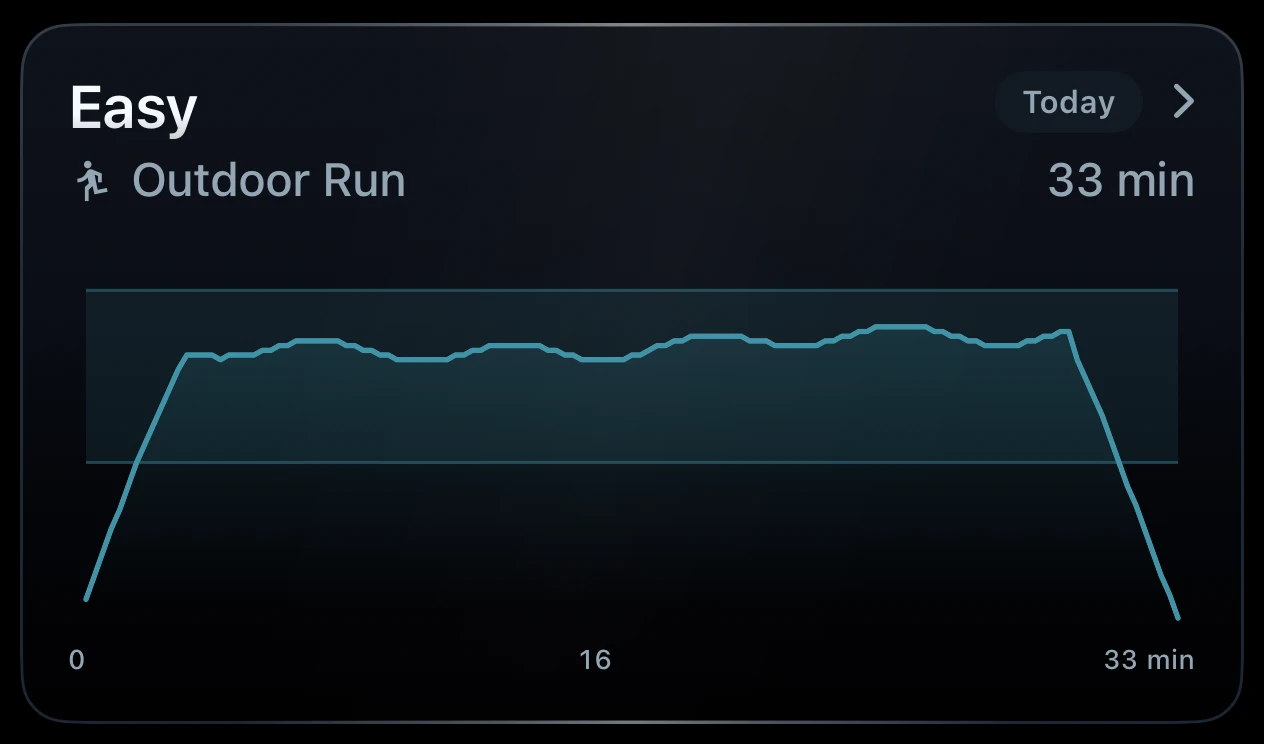
Diastra draws your Easy band from that max and sets the top edge by sex. The top is 79% of max for men and 83% for women. Those edges are close to the runner study's averages. A tap on your wrist tells you when you drift out of your band. Only the minutes that held in your band are credited. A walk break that stays in Easy is credited too. Diastra shows over the weeks whether your training is working. How Diastra draws your bands explains where each edge comes from.
See your own bands from your own workouts.
Diastra reads every workout your Apple Watch saved, finds your real max heart rate and draws Easy, Threshold and VO₂max from it. Then it holds you in your band on every run and shows you over the weeks whether your training is working.
Start my free trial$119 a year, or $19.99 a month. Seven days free. For iPhone and Apple Watch.
More questions
Is Zone 2 the same as Diastra's Easy band?
Easy is the Zone 2 you know, drawn more accurately. It runs from 60% of your max heart rate up to 79% for men and 83% for women. Those tops are close to where blood tests on runners show lactate starting to rise. Many Zone 2 charts stop at 70% for everyone.
Should I follow my heart rate or my breathing on easy runs?
Use both. Heart rate shows where you are against your bands, and breathing shows how the day feels. Slow down when either one tells you the effort is climbing.
Why is my heart rate higher than someone else's at the same pace?
Max heart rate differs from person to person. Measured max heart rate in a study of 165 recreational runners averaged 188 beats a minute, give or take about 8. Fitness changes the pace you can hold at each heart rate too. Compare your heart rate with your own bands and never with someone else's.
Is it bad to spend time above Zone 2?
No. Time between a 70% Zone 2 line and the top of Easy is still Easy. The space above Easy and below Threshold is the gray band, and time there is never harmful. Marathon pace often lands there for recreational runners.
Sources
- Nuuttila OP, Kaikkonen P, Sievänen H, Vasankari T, Kyröläinen H. 2025. The accuracy of fixed intensity anchors to estimate lactate thresholds in recreational runners. Eur J Appl Physiol 125(8):2161-2171.Blood tests on 165 recreational runners found lactate starts to rise at 78.9% of max for men and 83.6% for women. A fixed percentage of max missed each runner's threshold by about 7 beats a minute on average, and by about 9 with an age-formula max.
- Iannetta D, Inglis EC, Mattu AT, Fontana FY, Pogliaghi S, Keir DA, Murias JM. 2020. A critical evaluation of current methods for exercise prescription in women and men. Med Sci Sports Exerc 52(2):466-473.In 100 adults, the first lactate threshold fell anywhere from 60 to 90% of max heart rate.
- Tanaka H, Monahan KD, Seals DR. 2001. Age-predicted maximal heart rate revisited. J Am Coll Cardiol 37(1):153-156.A review of 351 studies with 18,712 people gave the formula 208 minus 0.7 times age for max heart rate.
- Lafrenz AJ, Wingo JE, Ganio MS, Cureton KJ. 2008. Effect of ambient temperature on cardiovascular drift and maximal oxygen uptake. Med Sci Sports Exerc 40(6):1065-1071.Ten trained men cycled at one steady, moderate effort. Between minute 15 and minute 45, heart rate rose 11% at 35°C and 2% at 22°C.
- Wingo JE, Lafrenz AJ, Ganio MS, Edwards GL, Cureton KJ. 2005. Cardiovascular drift is related to reduced maximal oxygen uptake during heat stress. Med Sci Sports Exerc 37(2):248-255.Nine cyclists held one steady, moderate effort at 35°C, and heart rate climbed from 151 to 169 beats a minute between minute 15 and minute 45.
- Minetti AE, Moia C, Roi GS, Susta D, Ferretti G. 2002. Energy cost of walking and running at extreme uphill and downhill slopes. J Appl Physiol 93(3):1039-1046.Ten runners on a treadmill used more energy for each meter as the uphill slope got steeper. On the steepest slope, walking took a little less energy than running.
- Swain DP, Abernathy KS, Smith CS, Lee SJ, Bunn SA. 1994. Target heart rates for the development of cardiorespiratory fitness. Med Sci Sports Exerc 26(1):112-116.In 162 young adults, heart rate as a share of max rose in step with the oxygen they used as a share of its max.
- Fleckenstein D, Seelhöfer J, Walter N, Ueberschär O. 2023. From incremental test to continuous running at fixed lactate thresholds: individual responses on %VO2max, %HRmax, lactate accumulation, and RPE. Sports (Basel) 11(10):198.Fifteen young trained runners held one fairly hard speed for 40 minutes. Their heart rate rose about 4% of max on average and up to 8% in one runner.
- Gaskill SE, Skinner JS, Quindry J. 2023. Ventilatory threshold related to VO2 reserve, heart rate reserve, and rating of perceived exertion in a large varied sample. Med Sci Sports Exerc 55(10):1876-1885.Across 863 exercise tests, people rated the first breathing threshold at 12.5 on the 6 to 20 effort scale, whatever their fitness.
- Persinger R, Foster C, Gibson M, Fater DC, Porcari JP. 2004. Consistency of the talk test for exercise prescription. Med Sci Sports Exerc 36(9):1632-1636.In 16 people on a treadmill and a bike, talking first became hard almost exactly at the first breathing threshold.
- Hunt KJ, Fankhauser SE, Saengsuwan J. 2015. Identification of heart rate dynamics during moderate-to-vigorous treadmill exercise. Biomed Eng Online 14:117.In 24 healthy men on a treadmill, heart rate made about two thirds of its change within about a minute of each change in speed.
- Matomäki P, Heinonen OJ, Nummela A, Kyröläinen H. 2024. Endurance training volume cannot entirely substitute for the lack of intensity. PLoS One 19(7):e0307275.In 35 untrained adults over 10 weeks, only easy cycling at 63% of max clearly improved low-intensity performance, and only hard training clearly improved high-intensity performance.