 Diastra
 VO₂max · Part 2 of 6
How to improve your VO₂max
Steady training and hard intervals both raise VO₂max, and reviews of many studies find that the intervals raise it a little more. One well-known study had men run four 4-minute intervals at 90 to 95% of max heart rate three times a week, and their VO₂max rose 7.2% in 8 weeks.
On this page
What raises VO₂max?
Both steady training and hard intervals raise VO₂max. VO₂max is your aerobic capacity. It is the most oxygen your body can use in a minute of all-out effort.
A 2015 review pooled 28 studies with 723 people[1]. They averaged 25 years old and started at a VO₂max of 40.8 mL/kg/min. Steady endurance training raised VO₂max by 4.9 mL/kg/min compared with no training. Interval training raised it by 5.5. In trials that compared the two head to head, intervals raised VO₂max about 1.2 mL/kg/min more than steady training[1].
A 2019 review pooled 53 trials of interval training[2]. Even intervals of 30 seconds or less raised VO₂max compared with no training. So did sessions with 5 minutes of hard work or less. So did programs that lasted 4 weeks or less.
The larger gains came from longer formats. Intervals of 2 minutes or more did better. So did sessions with 15 minutes or more of hard work and programs of 4 to 12 weeks. Only those longer formats beat steady moderate training[2].
What did the 4x4 study find?
Helgerud and colleagues tested the Norwegian 4x4 workout in a well-known 2007 study[3]. Forty moderately trained men were split into four groups. Each group trained three days a week for 8 weeks. All four groups did the same total amount of work.
- Long and slow. One group ran steadily at 70% of max heart rate.
- Steady and harder. One group ran at 85% of max.
- Short bursts. One group ran 15 seconds at 90 to 95% of max and then jogged 15 seconds at 70%, over and over.
- The 4x4. One group ran four 4-minute intervals at 90 to 95% of max, with 3 minutes of jogging at 70% between them.
The 4x4 group's VO₂max rose from 55.5 to 60.4 mL/kg/min. That is a gain of 7.2%. The short-burst group gained 5.5%. Both interval groups gained more than the two steady groups[3].
In the study, the amount of blood the heart pumped with each beat rose about 10% after the interval training. VO₂max moved in step with it[3]. Hard intervals train your heart to pump more blood with every beat. The Norwegian 4x4 workout walks through the full session step by step.
How hard is hard enough?
The 4x4 men worked at 90 to 95% of their max heart rate in each interval[3]. Type your age below to see the heart rates for each band. Diastra's VO₂max band starts at 92% of max.
Find your heart rate zones
Type your age. Add your sex and a max you have seen if you know them. The example below is a 35-year-old.
Age 35 · max heart rate 208 − 0.7 × 35 = 184, an estimate
Your Easy band, your Zone 2111 to 146beats a minute
Your Easy band runs 16 beats higher than the common Zone 2 chart lets you go.
Max from age uses Tanaka’s formula (208 − 0.7 × age). Easy ends where blood tests find lactate starting to rise, which is higher for women than for men. What you type stays on this page.
Diastra reads your max from your own Apple Watch workouts or a guided test and draws your bands from it.
Start my free trialHelgerud's range of 90 to 95% crosses that 92% line. An interval that holds at 92% of max or higher is in the VO₂max band. An interval that stays from 87% up to just under 92% is in Threshold.
A heart rate in the VO₂max band is a sign of very hard work. It does not prove your body is at its VO₂max in that moment. Heart rate and oxygen use rise together, but the match between them is loose.
Every band on that card is a share of your max heart rate. A max guessed from age is right on average, and it can miss a single runner by a wide margin. The max your own workouts have shown is a better place to start, and finding your max heart rate with Apple Watch shows how.
Do longer intervals work better?
Longer intervals gave bigger gains in two reviews. The 2019 review found larger gains from intervals of 2 minutes or more than from intervals of 30 seconds or less[2]. A 2013 review of 37 studies looked at interval training in 334 healthy people under 45[5].
In that review, VO₂max rose by about half a liter of oxygen a minute on average. The 9 studies with longer intervals showed gains of 0.8 to 0.9 liters a minute[5]. Those numbers are for the whole body before dividing by weight. Half a liter a minute works out to about 7 mL/kg/min for a runner who weighs 70 kilograms.
A 2013 study tested how long each interval should be[4]. Thirty-five trained cyclists took part for 7 weeks. Three groups of nine did two interval sessions a week plus easy rides. One group rode four 4-minute intervals. One rode four 8-minute intervals, and one rode four 16-minute intervals. Each rider went as hard as they could hold for that length. The other eight riders rode easy only.
The 4-minute group averaged 94% of peak heart rate. The 8-minute group averaged 90%, and the 16-minute group averaged 88%[4]. The study scored each rider on VO₂max and two power tests together. The 8-minute group improved 11.4% on that score. The 4-minute group improved 5.5%, and the 16-minute group improved 5.6%. The riders who rode easy only improved 4.2%[4].
The authors found that 32 minutes of work at about 90% of peak heart rate beat 16 minutes at about 95%. The 8-minute intervals also felt easier than the 4-minute ones[4]. These riders were cyclists, so their heart rate percentages came from a bike test and do not carry straight over to running.
Why does a big easy base matter?
Well-trained endurance athletes do most of their training at an easy effort. In a 2006 study, 11 well-trained junior cross-country skiers did about 75% of their endurance sessions at low intensity[6]. The authors wrote that elite athletes in several sports train the same way.
A 2007 study tested this in runners[7]. Twelve sub-elite runners trained for 5 months. One group spent about 80% of its training time at low intensity. The other group spent about 67% there and more time at a medium effort. Both groups did the same small share of hard work.
Both groups got faster in a 10.4-kilometer cross-country race. The mostly easy group cut 157 seconds from its time. The other group cut 121.5 seconds[7].
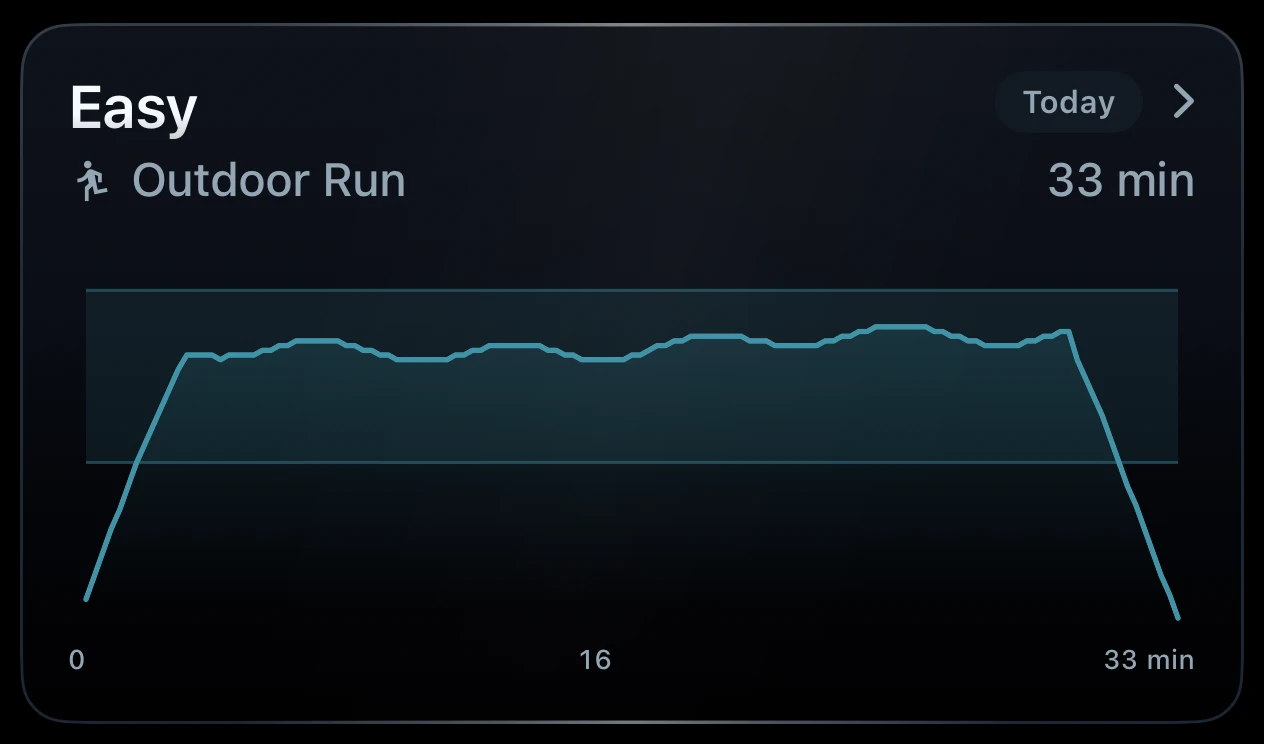
Easy is the pace you can hold a conversation at. Easy running builds your aerobic base. The Zone 2 you know from your watch is Diastra's Easy band. Diastra draws Easy from 60% of max up to 79% for men and 83% for women. Blood tests on 165 recreational runners found that lactate starts to rise close to those points on average[8].
Between Easy and Threshold is the gray band. For the men in the 4x4 study, 85% of max fell in that gray band. The group that trained there gained less VO₂max in 8 weeks than the two interval groups, and all four groups did the same total work[3]. The same amount of work done as hard intervals gave a bigger gain.
How to split a whole week between easy and hard is its own question. 80/20 running covers it.
How long until VO₂max goes up?
The 4x4 study saw its gain in 8 weeks[3]. The 2019 review found clear gains from programs of 4 weeks or less, and larger gains from programs of 4 to 12 weeks[2]. In a small cycling study, VO₂max rose within 3 weeks in both young and older men[9].
Those are averages for groups of people. One runner's own number can take longer to show a change. The 4x4 study ran for 8 weeks, and that is a fair length of time to give a block of training before you judge it.
The change can go the other way too. In a small study, seven trained people who stopped training lost 7% of their VO₂max in the first 21 days[11].
A watch estimate is a rough reading. In Apple's own test, a typical user's estimates varied by about 1.2 mL/kg/min, and one user in ten saw them vary by 2.6 or more[12]. So a change of a point or two on the watch can be noise. One reading is a data point, and a direction takes several weeks of readings.
The watch's level can also sit away from a lab result. An independent study found the watch read 6.1 mL/kg/min lower than a lab treadmill test on average[13].
To see where your number lands for your age and sex, use the chart in VO₂max by age.
What if your VO₂max does not move?
People who start less fit have more room to grow. In the 2015 review, interval training raised VO₂max about 3.2 mL/kg/min more in people who started less fit[1]. Fitter people still gain. The 4x4 men started at 55.5 and still rose 7.2% in 8 weeks[3].
The number of sessions made the difference in a 2017 study[10]. Seventy-eight healthy adults were split into five groups and trained for 6 weeks. The groups did one, two, three, four or five 60-minute sessions a week. The study measured fitness as the top workload each person reached in a hard test, and changes in that number tracked changes in VO₂max.
With one session a week, 69% of people showed no clear gain. With two sessions it was 40%, and with three it was 29%. With four or five sessions a week, everyone improved[10].
Then the people who had shown no gain trained 6 more weeks with two extra sessions a week. Every one of them improved[10]. The 2013 review saw the same thing. Every person in its studies with longer intervals showed a clear gain[5].
So a number that will not move can be a sign to look at the week. Count how many sessions you run. Then check whether your hard intervals reach the 90 to 95% of max that the 4x4 study used.
What does a week of VO₂max training look like?
Most runs in the week are Easy, and the hard interval session gets its own day. The 4x4 session runs like this.
- Run Easy to warm up until your legs feel loose.
- Run hard for 4 minutes and let your heart rate climb to 90 to 95% of max.
- Jog for 3 minutes at about 70% of max. That heart rate is inside Easy.
- Repeat the hard 4 minutes and the easy 3 minutes until you have run four hard intervals.
- Jog Easy to cool down until your breathing settles.
Put Easy days around the hard day. Some runners also add a Threshold run. Threshold is the fastest pace you can hold before fatigue stacks up quickly, and threshold runs explains how to pace one.
The 4x4 group in the study ran the session three times a week for 8 weeks[3]. The cyclists in the 2013 study did two interval sessions a week beside their easy rides[4].
Where does Diastra fit?
Diastra draws your VO₂max band from the max heart rate your own Apple Watch workouts have shown. The watch taps your wrist when you drift out of your band during a run, and only the minutes that held are credited. Diastra shows over the weeks whether your training is working.
See your own bands from your own workouts.
Diastra reads every workout your Apple Watch saved, finds your real max heart rate and draws Easy, Threshold and VO₂max from it. Then it holds you in your band on every run and shows you over the weeks whether your training is working.
Start my free trial$119 a year, or $19.99 a month. Seven days free. For iPhone and Apple Watch.
More questions
Do short 30-second intervals raise VO₂max?
Short intervals raise VO₂max too. In a 2019 review of 53 trials, intervals of 30 seconds or less raised VO₂max compared with no training[2]. In the 4x4 study, men who ran 15-second bursts at 90 to 95% of max raised their VO₂max 5.5% in 8 weeks[3]. Intervals of 2 minutes or longer gave larger gains in the review.
Does steady running raise VO₂max without intervals?
Steady endurance training raised VO₂max by 4.9 mL/kg/min in a 2015 review of mostly young adults who started at 40.8[1]. In the 4x4 study, the men who ran long and slow at 70% of max gained less than the two interval groups in 8 weeks[3]. Steady running builds the base, and intervals added a little more gain in the reviews.
Does age change how much you can gain?
Older people still gain. In a small cycling study, men who averaged 68 years old raised their VO₂max 31% in 12 weeks, and men who averaged 23 raised theirs 18%[9]. In the 2015 review, older people gained about 1.8 mL/kg/min more from intervals than from steady training[1]. The people in that review averaged 25, so older there means older within a young group.
How fast does VO₂max fade if you stop training?
VO₂max fell 7% in the first 21 days in a small study of seven trained people who stopped training[11]. By day 56 it had settled 16% below where it started. After 84 days their average of 50.8 mL/kg/min was still above the 43.3 of eight people who had never trained.
Sources
- Milanović Z, Sporiš G, Weston M. 2015. Effectiveness of high-intensity interval training (HIT) and continuous endurance training for VO2max improvements. A systematic review and meta-analysis of controlled trials. Sports Med 45(10):1469-1481.28 studies with 723 people found steady training raised VO₂max 4.9 mL/kg/min and intervals 5.5, with intervals ahead by about 1.2 and bigger gains for people who started less fit.
- Wen D, Utesch T, Wu J, Robertson S, Liu J, Hu G, Chen H. 2019. Effects of different protocols of high intensity interval training for VO2max improvements in adults. A meta-analysis of randomised controlled trials. J Sci Med Sport 22(8):941-947.53 trials found that even short intervals raised VO₂max, and that intervals of 2 minutes or more, 15 minutes or more of hard work and programs of 4 to 12 weeks raised it most.
- Helgerud J, Høydal K, Wang E, Karlsen T, Berg P, Bjerkaas M, Simonsen T, Helgesen C, Hjorth N, Bach R, Hoff J. 2007. Aerobic high-intensity intervals improve VO2max more than moderate training. Med Sci Sports Exerc 39(4):665-671.40 moderately trained men trained three times a week for 8 weeks. Four 4-minute intervals at 90 to 95% of max raised VO₂max 7.2%, and both interval groups gained more than the two steady groups.
- Seiler S, Jøranson K, Olesen BV, Hetlelid KJ. 2013. Adaptations to aerobic interval training. Interactive effects of exercise intensity and total work duration. Scand J Med Sci Sports 23(1):74-83.35 trained cyclists took part for 7 weeks. Three groups of nine did two interval sessions a week plus easy rides, and eight rode easy only. Four 8-minute intervals gave an 11.4% gain on a combined VO₂max and power score, against 5.5% for four 4-minute intervals, 5.6% for four 16-minute intervals and 4.2% for easy riding only.
- Bacon AP, Carter RE, Ogle EA, Joyner MJ. 2013. VO2max trainability and high intensity interval training in humans. A meta-analysis. PLoS One 8(9):e73182.37 studies with 334 healthy people under 45 found interval training raised VO₂max by 0.51 liters a minute, and the 9 studies with longer intervals showed 0.8 to 0.9 liters a minute with a clear gain in every person.
- Seiler KS, Kjerland GØ. 2006. Quantifying training intensity distribution in elite endurance athletes: is there evidence for an “optimal” distribution? Scand J Med Sci Sports 16(1):49-56.11 well-trained junior cross-country skiers did about 75% of their endurance sessions at low intensity, a pattern the authors say matches reports on elite athletes across several sports.
- Esteve-Lanao J, Foster C, Seiler S, Lucia A. 2007. Impact of training intensity distribution on performance in endurance athletes. J Strength Cond Res 21(3):943-949.12 sub-elite runners trained for 5 months. The group with about 80% of its time at low intensity cut 157 seconds from a 10.4 km race, against 121.5 seconds for the group with about 67% there.
- Nuuttila OP, Kaikkonen P, Sievänen H, Vasankari T, Kyröläinen H. 2025. The accuracy of fixed intensity anchors to estimate lactate thresholds in recreational runners. Eur J Appl Physiol 125(8):2161-2171.Blood tests on 165 recreational runners found lactate starts to rise at 78.9% of max for men and 83.6% for women on average.
- Murias JM, Kowalchuk JM, Paterson DH. 2010. Time course and mechanisms of adaptations in cardiorespiratory fitness with endurance training in older and young men. J Appl Physiol 108(3):621-627.8 older and 8 young men cycled 45 minutes three times a week. VO₂max rose within 3 weeks, and after 12 weeks the older men had gained 31% and the young men 18%.
- Montero D, Lundby C. 2017. Refuting the myth of non-response to exercise training. 'Non-responders' do respond to higher dose of training. J Physiol 595(11):3377-3387.78 healthy adults trained one to five 60-minute sessions a week for 6 weeks. The share with no clear gain fell from 69% at one session to none at four or five, and everyone who had shown no gain improved after 6 more weeks with two extra sessions a week.
- Coyle EF, Martin WH 3rd, Sinacore DR, Joyner MJ, Hagberg JM, Holloszy JO. 1984. Time course of loss of adaptations after stopping prolonged intense endurance training. J Appl Physiol 57(6):1857-1864.Seven trained people who stopped training lost 7% of their VO₂max in 21 days and settled 16% lower by day 56, still above people who had never trained.
- Apple. May 2021. Using Apple Watch to Estimate Cardio Fitness with VO2 max. Apple white paper. Read October 4, 2026.Apple compared its estimate with a lab reference in 221 people and found an average error of 1.4 mL/kg/min with a spread of 4.7. A typical user's own estimates varied by about 1.2 mL/kg/min, and one user in ten saw them vary by 2.6 or more.
- Lambe R, O'Grady B, Baldwin M, Doherty C. 2025. Investigating the accuracy of Apple Watch VO2 max measurements: A validation study. PLoS One 20(5):e0323741.In 28 adults who also ran a lab treadmill test, Apple Watch read 6.1 mL/kg/min lower on average.