 Diastra
 Is my training working · Part 3 of 3
How long does it take to recover after a marathon or half marathon?
Keep the first days after a race easy or off, and bring back hard runs once your easy runs feel normal again. Leg strength came back within two days of a half marathon in one study, while marathon runners still had weaker legs a week later and muscle repair that went on for three to four weeks.
On this page
- What does a race do to your legs?
- How long does it take to recover after a half marathon?
- How long does it take to recover after a marathon?
- Do you rest or run in the days after a race?
- What does your heart rate show in the week after a race?
- When can you run hard again after a race?
- What Diastra does after race day
- More questions
- Sources
What does a race do to your legs?
A race pushes your legs harder and longer than most training runs. It leaves small areas of damage in the muscle. That damage takes days to weeks to mend.
Blood tests show the damage signal peaks late. A muscle protein leaks into the blood after hard running. In seven experienced triathletes it peaked two days after a marathon.[2]
The muscle also runs low on fuel. Muscles store carbohydrate as glycogen. Sherman and colleagues measured it in the calves of 10 well-trained runners.[3] The runners had loaded up on carbohydrate before the race, so they started high at 196 units. The marathon cut it to 25. A week later it was 141 in the runners who rested and 109 in the runners who kept running. The gap between those two groups was too small to be sure of. Neither group was back to where it started.
How long does it take to recover after a half marathon?
A half marathon is shorter, and the legs come back faster. Wang and colleagues tested thigh strength in 38 recreational runners before and after a half marathon.[5] Strength dropped right after the race. Most of it was back the next day, and all of it was back within two days. The authors still advised against hard exercise in those two days.
Strength is only one part of recovery. Zhou and colleagues scanned the thigh muscles of 24 male amateur runners before a half marathon and for three days after it.[6] Three hours after the race, every runner's scans showed small damage. The runners were split into three groups. One group rested. One group ran 30 minutes a day at a moderate effort, set halfway between resting heart rate and max. The third group ran 30 minutes a day at a harder effort.
By 72 hours the resting group's scans were back to where they started. The moderate group was partly back. The harder group had not recovered at all.[6]
So after a half marathon, leg strength can be back within two days. The muscle itself settles faster when those first three days stay quiet.
How long does it take to recover after a marathon?
A marathon takes longer. Sherman and colleagues tested leg strength in 10 trained men for a week after a marathon.[4] Strength fell after the race and stayed low the next day. It climbed through day 7 in the men who rested. It was still below its pre-race level a week after the race.
Noble and colleagues followed seven runners from the 1976 Boston Marathon.[8] Each runner did a 30-minute treadmill run at planned race pace a week before the race. They repeated it 2 to 3 days, 6 to 7 days and 13 to 15 days after the race. The run felt harder at both checks in the first week. The authors linked that to sore and stiff muscles. By day 13 to 15 almost every measure was back to its pre-race level. An all-out treadmill test two weeks after the race matched the one before it.
Repair inside the muscle runs longer than the feeling. Warhol and colleagues took calf muscle samples from 40 male marathon runners at different times after a race.[1] In the first one to three days the samples showed small areas of damaged fibers. Repair was well along by three to four weeks. Signs of rebuilding were still there at 8 to 12 weeks.
So after a marathon your legs can feel close to normal in about two weeks. The muscle keeps repairing for weeks after that.
Do you rest or run in the days after a race?
The studies point two ways, and both ways keep things easy.
Two small trials favored full rest. In Sherman's study, one group rested for the week after the marathon.[4] The other group ran 20 to 45 minutes a day at an easy effort. The resting runners had their leg work capacity back by day 3. The runners who kept running were still below it at day 7. In the half marathon scans, full rest also brought the muscle back fastest.[6]
A larger trial found no harm from steady exercise near the top of easy effort. Martínez-Navarro and colleagues split 64 marathon finishers into three groups.[7] One group rested. The other two groups ran or used an elliptical machine for 40 minutes on days 2, 4 and 6, at about the heart rate of their first threshold. Blood markers of muscle damage recovered at the same rate in all three groups. The running group jumped higher on day 4 than the group that rested.
So rest days are a good choice for the first few days. In the half marathon scans, even moderate runs in the first three days slowed the muscle's recovery, and harder runs slowed it more.[6] From day 2 on, steady 40-minute sessions did no harm to the blood markers in the marathon trial.[7]
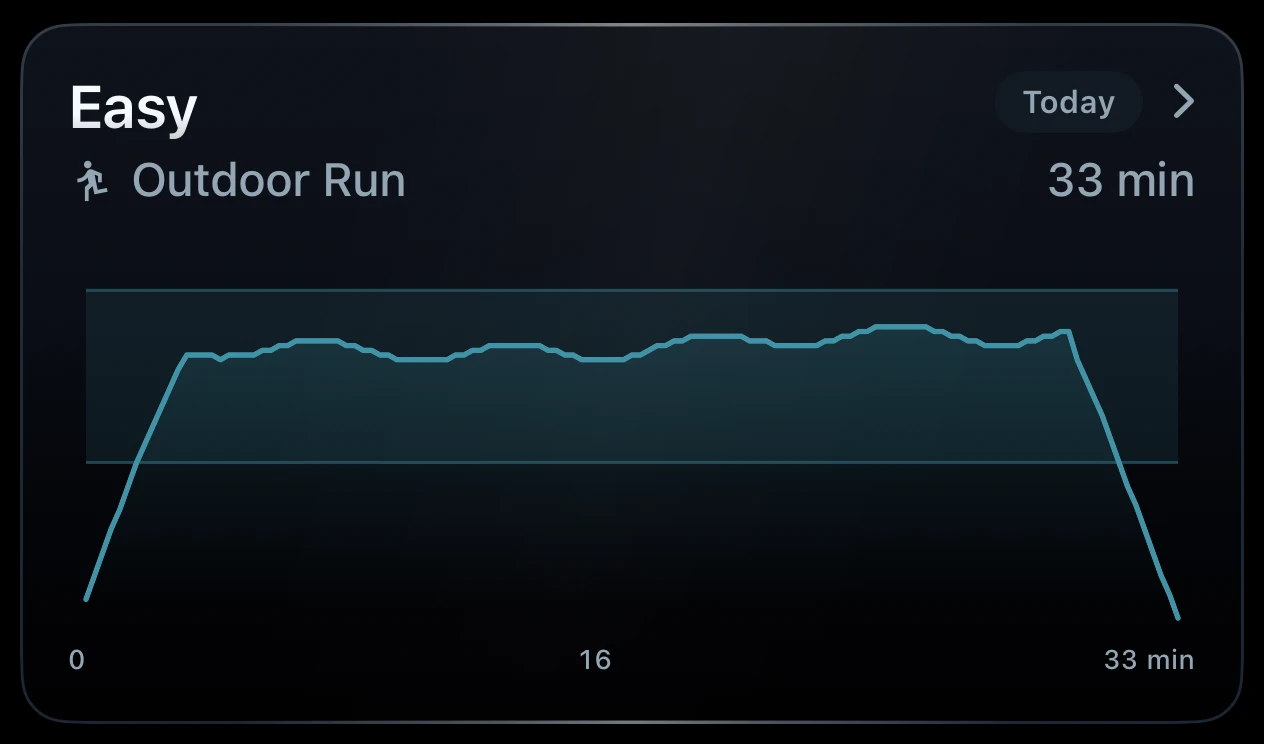
If you run, keep every run inside your Easy band. Easy is the Zone 2 most runners know, drawn up to where lactate starts to rise in the blood. Blood tests on 165 runners put that point at 78.9% of max heart rate for men and 83.6% for women on average.[14] The Easy band below runs from 60% of max up to 79% for men and 83% for women. Type your age to see yours.
Find your heart rate zones
Type your age. Add your sex and a max you have seen if you know them. The example below is a 35-year-old.
Age 35 · max heart rate 208 − 0.7 × 35 = 184, an estimate
Your Easy band, your Zone 2111 to 146beats a minute
Your Easy band runs 16 beats higher than the common Zone 2 chart lets you go.
Max from age uses Tanaka’s formula (208 − 0.7 × age). Easy ends where blood tests find lactate starting to rise, which is higher for women than for men. What you type stays on this page.
Diastra reads your max from your own Apple Watch workouts or a guided test and draws your bands from it.
Start my free trialWhat does your heart rate show in the week after a race?
Heart rate gives some clues after a race. It also misses some.
The clearest change shows up at night. Hynynen and colleagues measured heart rate during sleep in 10 active men.[10] After a moderate run, their sleeping heart rate averaged 9% above its rest-day level. After a marathon it averaged 30% above it.
Right after a marathon, the same pace also takes more heartbeats. Kyröläinen's triathletes ran 5 minutes at marathon pace before and after the race.[2] After the race, that pace took more oxygen and a higher heart rate.
A few days later the picture changes. In the Boston study, heart rate at race pace did not change in the weeks after the marathon, even while the runs felt harder.[8] In a Dutch study, top running speed dropped for a few days after a race, and heart rate did not show the drop.[9]
So a heart rate above your own normal on an easy run is a sign to keep the week easy. A heart rate at your usual level does not prove your legs have recovered. In the first week, how the run feels tells you more.
If your watch's VO₂max number drops after a race, why your Apple Watch VO₂max dropped explains why the estimate moves.
What about heart rate recovery after a run?
Heart rate recovery is how far your heart rate drops in the minute after you stop. It tends to get faster over months as fitness grows. A review found that most of the 8 studies that followed athletes over time saw it rise along with their training.[11] The review also found that age, heat and the effort before the stop make the numbers hard to compare.
The days after a long race add a twist. Mann and colleagues tested 10 runners a week before an 87 km race and again 2 to 4 days after it.[12] Each runner did 20 minutes on a treadmill at the same steady effort both times. Their heart rate during the run did not change. After the race the run felt harder, rated 13 against 11 on an effort scale. Their heart rate also fell faster after the run, by 35 beats against 29. The authors wrote that a faster drop may not always mean a fitter runner.
So read heart rate recovery as a trend over weeks. Compare it only with your own runs of the same kind. One fast drop in race week is a single reading. It is no sign of new fitness.
When can you run hard again after a race?
Hard sessions come back once your legs have. A few studies show when that tends to happen.
Even one hard session needs time. A 2013 review tracked the calming nerve signal that slows the heart after exercise.[13] That signal came back within 24 hours of easy exercise. It took 24 to 48 hours after threshold work and at least 48 hours after high-intensity work. It came back faster in fitter people. A race is a long and hard effort, so give it at least that long.
After a half marathon, the studies point to waiting at least two or three days. Thigh strength took two days to come back.[5] Harder runs in the first three days kept the muscle from settling.[6] In the Dutch study, top speed was 2 to 4% lower three days after a 25 km race, which is a little longer than a half marathon. By day 5 the gap was gone.[9]
After a marathon, wait longer. Leg strength was still below its pre-race level a week after the race.[4] Race pace felt harder for a week, and the all-out test matched the pre-race test by two weeks.[8]
Look for three signs before your first hard session.
- Your easy runs feel easy again. Your usual easy run pace no longer feels harder than it should.
- Your heart rate on an easy run is back near your own normal. Compare it with easy runs from before the race.
- Your legs feel fresh. The soreness and stiffness are gone.
Make the first hard session shorter than usual. A short threshold run or a few intervals is enough. Threshold is the fastest pace you can hold before fatigue stacks up quickly. VO₂max is your aerobic capacity. Intervals like the Norwegian 4x4 train it and can come after that.
What Diastra does after race day
Diastra reads every workout your Apple Watch saved in Apple Health, so your race and every run after it go into your history. When you set a race date, no Threshold or VO₂max session is planned on race day or in the seven days after it. A hard session that would have landed in that week is dropped. It is never moved to another day or added to the next week. When you rest instead of running, your week is redrawn around the workouts you did. In the weeks after, a hard session moves when your recovery signals are down, and that day stays easy. On every run the watch taps your wrist when you drift out of your band. Over the weeks Diastra shows whether your training is working.
See your own bands from your own workouts.
Diastra reads every workout your Apple Watch saved, finds your real max heart rate and draws Easy, Threshold and VO₂max from it. Then it holds you in your band on every run and shows you over the weeks whether your training is working.
Start my free trial$119 a year, or $19.99 a month. Seven days free. For iPhone and Apple Watch.
More questions
Why do my legs feel worse two days after a race?
Muscle damage shows up late. In one study a muscle protein that leaks into the blood peaked two days after a marathon. Boston Marathon runners also rated a race-pace run as harder 2 to 3 days after the race, and the authors linked it to sore and stiff muscles.
Does a 5K or 10K need a recovery week?
Shorter races ask less of the legs, and the studies on this page tested halves and marathons. A 5K or 10K is still a hard effort. A review found that the calming nerve signal to the heart took at least 48 hours to come back after high-intensity work. A few easy days before the next hard session follow that finding.
Can I cross-train instead of running the week after a marathon?
Yes. In a trial of 64 marathon finishers, one group used an elliptical machine for 40 minutes on days 2, 4 and 6. Their blood markers of muscle damage recovered at the same rate as the runners and the resters. Keep the effort easy on any machine.
Sources
- Warhol MJ, Siegel AJ, Evans WJ, Silverman LM. 1985. Skeletal muscle injury and repair in marathon runners after competition. Am J Pathol 118(2):331-339.Calf muscle samples from 40 male marathon runners showed small areas of damaged fibers 1 to 3 days after a race, repair well along by 3 to 4 weeks and signs of rebuilding at 8 to 12 weeks.
- Kyröläinen H, Pullinen T, Candau R, Avela J, Huttunen P, Komi PV. 2000. Effects of marathon running on running economy and kinematics. Eur J Appl Physiol 82(4):297-304.In 7 experienced triathletes, a 5-minute run at marathon pace took more oxygen and a higher heart rate after the marathon than before it, and a muscle protein in the blood peaked 2 days after the race.
- Sherman WM, Costill DL, Fink WJ, Hagerman FC, Armstrong LE, Murray TF. 1983. Effect of a 42.2-km footrace and subsequent rest or exercise on muscle glycogen and enzymes. J Appl Physiol 55(4):1219-1224.In 10 well-trained runners who had loaded up on carbohydrate, calf glycogen fell from 196 to 25 units in the marathon and a week later was 141 in the resters and 109 in the runners, a gap the study did not find significant.
- Sherman WM, Armstrong LE, Murray TM, Hagerman FC, Costill DL, Staron RC, Ivy JL. 1984. Effect of a 42.2-km footrace and subsequent rest or exercise on muscular strength and work capacity. J Appl Physiol 57(6):1668-1673.Ten trained men who rested for a week after a marathon had leg work capacity back by day 3, while men who ran 20 to 45 minutes a day were still below at day 7, and leg strength stayed below its pre-race level.
- Wang W, Xu S, Zedler M, Jing Y, Potthast W. 2025. Tracking of time-dependent changes in concentric and eccentric quadriceps and hamstring torques and powers after a half-marathon. J Sports Sci 43(11):1070-1075.In 38 recreational runners, thigh strength fell after a half marathon, most of it was back within 1 day and all of it within 2 days.
- Zhou J, Xu C, Wu Y, Mao X, Hu Z, Wei Z, Li Y, Huang J. 2026. Quantitative MRI evaluation of the effects of rest and different intensities of running on the recovery of thigh muscle microdamage after a half marathon. BMC Sports Sci Med Rehabil 18(1):192.In 24 male amateur runners, thigh muscle scans were back to baseline 72 hours after a half marathon with full rest, partly back with daily 30-minute runs at a moderate effort and not back with harder runs.
- Noble BJ, Maresh CM, Allison TG, Drash A. 1979. Cardio-respiratory and perceptual recovery from a marathon run. Med Sci Sports 11(3):239-243.Seven Boston Marathon runners ran 30 minutes at race pace after the race. Heart rate did not change, the runs felt harder for a week, and the measures were back by day 13 to 15.
- Verstappen FT, Janssen GM, Does RJ. 1989. Effects of endurance training and competition on exercise tests in relatively untrained people. Int J Sports Med 10 Suppl 3:S126-S131.Three days after a 25 km race or a marathon, top treadmill speed was 2 to 4% lower than before it, the gap was gone by day 5, and heart rate did not show the drop.
- Hynynen E, Vesterinen V, Rusko H, Nummela A. 2010. Effects of moderate and heavy endurance exercise on nocturnal HRV. Int J Sports Med 31(6):428-432.In 10 active men, heart rate during sleep averaged 109% of its rest-day level after a moderate run and 130% after a marathon.
- Daanen HA, Lamberts RP, Kallen VL, Jin A, Van Meeteren NL. 2012. A systematic review on heart-rate recovery to monitor changes in training status in athletes. Int J Sports Physiol Perform 7(3):251-260.Most of 8 studies that followed athletes over time found heart rate recovery rose with training status, and age, heat and the effort before the stop made studies hard to compare.
- Mann TN, Platt CE, Lamberts RP, Lambert MI. 2015. Faster heart rate recovery with increased RPE: paradoxical responses after an 87-km ultramarathon. J Strength Cond Res 29(12):3343-3352.Two to four days after an 87 km race, 10 runners rated a set treadmill run harder (13 against 11) while their heart rate fell faster after it (35 beats against 29).
- Stanley J, Peake JM, Buchheit M. 2013. Cardiac parasympathetic reactivation following exercise: implications for training prescription. Sports Med 43(12):1259-1277.The calming nerve signal to the heart came back within 24 hours of easy exercise, in 24 to 48 hours after threshold work and in at least 48 hours after high-intensity work.
- Nuuttila OP, Kaikkonen P, Sievänen H, Vasankari T, Kyröläinen H. 2025. The accuracy of fixed intensity anchors to estimate lactate thresholds in recreational runners. Eur J Appl Physiol 125(8):2161-2171.Blood tests on 165 recreational runners put the first lactate threshold at 78.9% of max heart rate for men and 83.6% for women.