 Diastra
 Is my training working · Part 2 of 3
Why did my Apple Watch VO₂max drop?
Cardio Fitness can drop after a hot or hilly week, because heat, hills and a heavy pack raise your heart rate in ways the watch reads as lower fitness. A real loss after time off shows up as a slide across several weeks, and one study measured 7% in the first 21 days with no training.
On this page
Can one week of runs lower the number?
It can. Cardio Fitness is Apple's estimate of your VO₂max. VO₂max is your aerobic capacity. It is the most oxygen your body can use when you go all-out. You will see it written as mL/kg/min, and this page calls one of those units a point.
The estimate moves even when your fitness does not. Apple followed 221 people for about 390 days on average[1]. A typical person's estimates spread by 1.2 points around their own average. One person in ten saw a spread of 2.6 points or more[1].
Here is what that looks like with real numbers. Say your readings usually land near 42. A week of readings at 40 or 41 can come from that ordinary spread. For one person in ten, a reading near 39 can come from it too.
Across months the estimate holds together better. Apple compared each person's last estimate with one from more than 28 days before. The two agreed with a score of 0.86 on a scale where 1.0 is a perfect match[1]. So the trend over months tells you more than any single week.
Which of your runs could have pulled it down?
Look at the walks and runs from the days before the drop. Apple's paper names the conditions that can pull an estimate low[1].
- Heat. Extreme heat raises your heart rate.
- Not drinking enough. Dehydration raises your heart rate too.
- Caffeine. Apple lists it with the things that raise heart rate.
- High altitude. A recent move to high altitude is on the same list.
- A heavy load. A heavy backpack or a child you carry makes you work harder.
- Soft ground. Sand makes each step take more work.
The watch cannot see any of these. It sees a higher heart rate at your usual pace and reads it as lower fitness. The authors of a 2026 study of the Series 10 made the same point about terrain, slope and heat[4].
Hills matter too. Apple Watch makes its estimate on fairly flat ground. Apple sets the limit at a slope under 5% up or down[1]. A hilly route gives the watch fewer stretches it can use.
Apple also says pushing a stroller can lower the accuracy of an estimate or keep one from being made[1].
If the drop came in the week after a race, running after a race covers what heart rate does in those days.
Did your training change?
A change in how you train can move the number with no change in your fitness.
Fewer outdoor workouts. Apple makes the estimate from Outdoor Walk, Outdoor Run and Hiking workouts[2]. Indoor workouts are left out, and that includes workouts on gym equipment[2]. A month on the treadmill gives the watch no new workouts to read. Apple says more outdoor walks, runs and hikes make an estimate more likely and more accurate[1].
Walks in place of runs. The watch can also make an estimate during an everyday outdoor walk with no workout running. In Apple's own test those walking estimates came out close to the workout estimates[1]. Apple also says harder efforts during workouts make an estimate more accurate[1]. So a stretch of easy walks gives the watch fewer of the harder efforts that help it.
A loose watch. Apple suggests a tighter band for workouts, because the heart rate sensor should stay close to your skin[3]. In the cold, blood flow in the skin of your wrist can drop too low for the sensor to get a reading[3].
Your Health details. Apple's paper says a wrong age, sex or weight in the Health app can keep your estimates off[1]. VO₂max is a figure per kilogram of body weight, so your weight is part of the number. The estimate also needs a sense of your peak heart rate, even though you never have to reach it[1].
The guide to Apple Watch VO₂max accuracy covers how far the estimate lands from a lab test.
What does a real drop after a break look like?
A real loss of fitness after time off is a slide over weeks. A 1984 study followed 7 trained endurance athletes who stopped training[5]. Their VO₂max fell 7% in the first 21 days. It kept falling and settled 16% below where it started by day 56. After 84 days it was still higher than in 8 people who had never trained[5].
A 2022 study found the same early drop. Two weeks without training lowered VO₂max in 15 trained young men[6].
A two-part review from 2000 split breaks into two kinds. In breaks shorter than 4 weeks, highly trained athletes lost VO₂max and blood volume quickly. People who had only started training lost less in that time[7]. In breaks longer than 4 weeks, athletes lost more but stayed above people who had never trained. People who had trained only recently lost their recent gains[8].
Fitness comes back with training. A 2024 case study followed one 53-year-old triathlete through 12 weeks off and 12 weeks back[11]. His VO₂max for running fell 10.9% during the break. Twelve weeks of structured training brought it back to where it started. That is one person, so another runner may take more or less time.
Now put the sizes side by side. A 7% loss on a VO₂max of 45 is about 3 points. One person in ten sees a 2.6-point spread in their readings with no change in fitness at all[1]. So one low reading cannot tell a three-week break from a hot week.
The shape over several weeks can. A break shows up as readings that keep sliding across comparable outdoor runs. A hot or hilly week can show up as a few low readings that come back once the weather cools or the route flattens. The table puts the two side by side.
| What to look at | A dip from conditions | A drop after a break |
|---|---|---|
| What came before | Heat, hills, sand or a heavy load[1] | Two weeks or more with little or no training[6] |
| How big | About the 1.2-point spread of a typical person, or 2.6 for one person in ten[1] | 7% in 21 days in one study, about 3 points at a VO₂max of 45[5] |
| How it moves | A few low readings among your usual ones | Readings that keep sliding across comparable runs |
| What brings it back | Flatter routes and cooler weather | Weeks of training[11] |
How do you hold your fitness through a busy stretch?
Keep some hard running in the week and cut the volume. A 2000 review found that losses can be avoided or limited when training intensity stays the same and the number of sessions drops only a little. The total volume can drop a lot[8].
Two studies show it. In a 1981 study, 12 young adults trained 6 days a week for 10 weeks[9]. Then they trained either 4 or 2 days a week for 15 more weeks. Their sessions kept the same effort and the same length. VO₂max held at its trained level in both groups[9].
In a 1990 study, 10 well-trained runners cut their weekly distance by 70% for 3 weeks[10]. They ran 5 days a week in place of 6 and kept some intervals and races in the week. Their VO₂max and their 5 km race times did not change[10].
Both studies kept the effort the same and cut how much training there was. A short busy stretch with that shape can leave your fitness close to where it was.
What should you do after a drop?
- Check the conditions. Look at the heat, the hills and any load on the walks and runs before the drop.
- Compare like with like. Read the number after flat outdoor runs in similar weather.
- Use the longer view. The Health app shows your average for a day, a week, a month, six months or a year[2]. The six month view shows the trend.
- Check your Health details. Make sure your age, sex and weight are right[1].
- Rebuild after a break with easy running. Add easy minutes back week by week, at the pace easy run pace describes.
- Give it weeks. The guide on VO₂max not improving shows how long a gain takes to show.
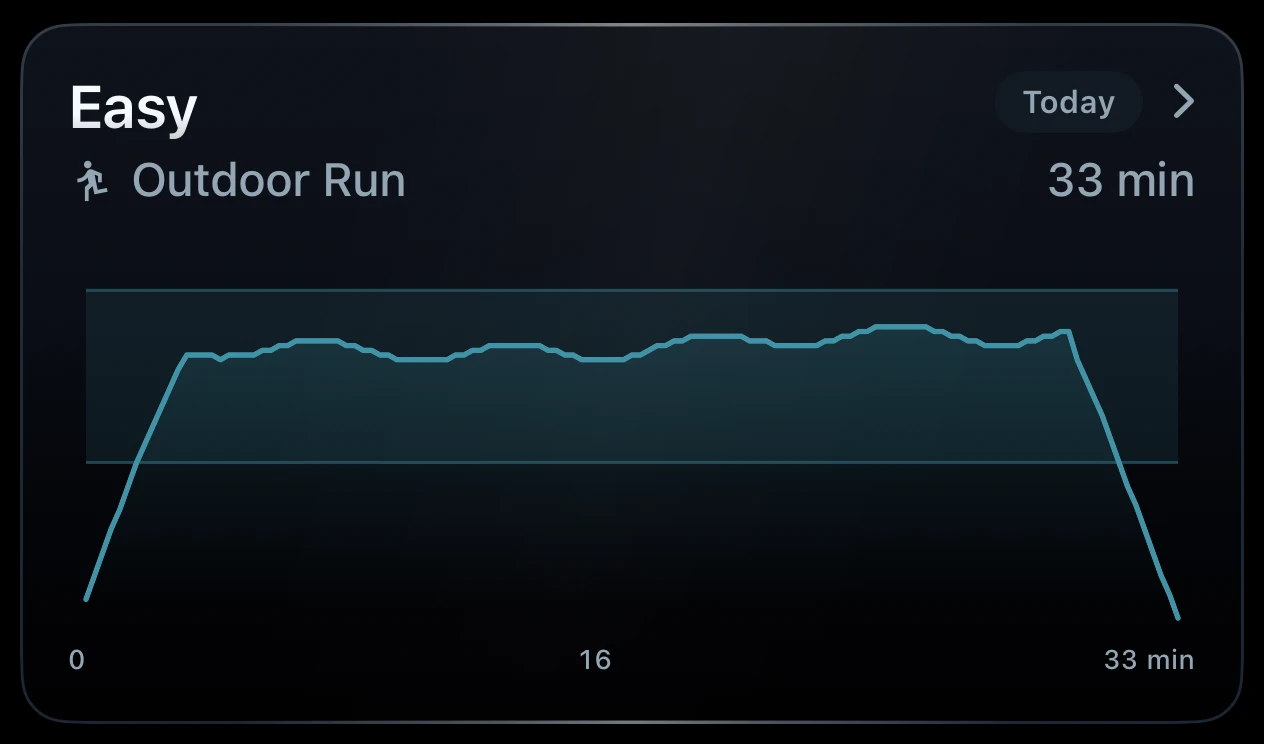
Easy is the pace you can hold a conversation at, and it builds your aerobic base. The Zone 2 you know is Diastra's Easy band. Type your age below to see your own bands.
Find your heart rate zones
Type your age. Add your sex and a max you have seen if you know them. The example below is a 35-year-old.
Age 35 · max heart rate 208 − 0.7 × 35 = 184, an estimate
Your Easy band, your Zone 2111 to 146beats a minute
Your Easy band runs 16 beats higher than the common Zone 2 chart lets you go.
Max from age uses Tanaka’s formula (208 − 0.7 × age). Easy ends where blood tests find lactate starting to rise, which is higher for women than for men. What you type stays on this page.
Diastra reads your max from your own Apple Watch workouts or a guided test and draws your bands from it.
Start my free trialThe top band shares its name with the number on your watch. That VO₂max band is for hard intervals, and the guide on how to improve VO₂max shows how a week puts the two together.
Where does Diastra fit?
Diastra does not use the Cardio Fitness number. It reads every workout your Apple Watch saved in Apple Health, treadmill runs included. It finds your max heart rate in those workouts and draws Easy, Threshold and VO₂max from it. It credits only the minutes your heart held in a band. Over the weeks Diastra shows whether your training is working. Getting fitter. Holding steady. Slipping.
See your own bands from your own workouts.
Diastra reads every workout your Apple Watch saved, finds your real max heart rate and draws Easy, Threshold and VO₂max from it. Then it holds you in your band on every run and shows you over the weeks whether your training is working.
Start my free trial$119 a year, or $19.99 a month. Seven days free. For iPhone and Apple Watch.
More questions
Why did Cardio Fitness change on a day you did not work out?
Apple Watch can make an estimate during an everyday outdoor walk with no workout running[1]. The Health app can also offer to update your earlier estimates when it finds they could be more accurate[2]. Either one can move the number on a rest day.
Can a few days off lower your VO₂max?
The studies measured weeks rather than days. Two weeks with no training lowered VO₂max in 15 trained young men[6]. Three weeks with 70% less running and some intervals kept in the week left VO₂max unchanged in 10 well-trained runners[10].
Can a treadmill run lower your Cardio Fitness?
A treadmill run cannot lower it, because Apple leaves indoor workouts out of the estimate[2]. Apple tells you to log a treadmill run as Indoor Run[3]. A long stretch on the treadmill means fewer new estimates. The number you see may then come from a few outdoor walks.
Sources
- Apple. May 2021. Using Apple Watch to Estimate Cardio Fitness with VO2 max. Apple white paper. Read October 6, 2026.Heat, dehydration, caffeine, high altitude, a heavy load and sand can pull an estimate low, and a wrong age, sex or weight can keep it off. A typical person's estimates spread by 1.2 points, and one in ten by 2.6 or more.
- Apple Support. Track your cardio fitness levels. Published September 14, 2026. Read October 6, 2026.The workouts that give an estimate, the rule that leaves indoor workouts out, the day to year views and the Update Your Data option.
- Apple Support. Get the most accurate measurements using your Apple Watch. Published March 10, 2026. Read October 6, 2026.A tighter band for workouts keeps the heart rate sensor close to the skin, and cold can lower blood flow in the wrist too far for a reading.
- Lambe R, Schumann M, Donnelly L, Hamilton S, Lally S, Rafter E, O'Reilly S, White T, Doherty C. 2026. Accuracy of VO2 max Estimates From Apple Watch Series 10. Mayo Clin Proc Digit Health 4(2):100357.35 adults with a Series 10. The authors write that terrain, slope and heat can make the watch read a higher heart rate as lower fitness.
- Coyle EF, Martin WH 3rd, Sinacore DR, Joyner MJ, Hagberg JM, Holloszy JO. 1984. Time course of loss of adaptations after stopping prolonged intense endurance training. J Appl Physiol 57(6):1857-1864.7 trained people stopped training. VO₂max fell 7% in 21 days and settled 16% lower by day 56, still above 8 people who had never trained.
- Chen YT, Hsieh YY, Ho JY, Lin TY, Lin JC. 2022. Two weeks of detraining reduces cardiopulmonary function and muscular fitness in endurance athletes. Eur J Sport Sci 22(3):399-406.15 endurance-trained men aged 19 to 26 stopped training for 2 weeks, and their VO₂max fell.
- Mujika I, Padilla S. 2000. Detraining. Loss of training-induced physiological and performance adaptations. Part I. Short term insufficient training stimulus. Sports Med 30(2):79-87.In breaks under 4 weeks, highly trained athletes lose VO₂max and blood volume quickly, and recently trained people lose less.
- Mujika I, Padilla S. 2000. Detraining. Loss of training-induced physiological and performance adaptations. Part II. Long term insufficient training stimulus. Sports Med 30(3):145-154.In breaks over 4 weeks, athletes stay above untrained levels and recent gains fade. Keeping the intensity while cutting volume avoids or limits the loss.
- Hickson RC, Rosenkoetter MA. 1981. Reduced training frequencies and maintenance of increased aerobic power. Med Sci Sports Exerc 13(1):13-16.12 young adults trained 6 days a week for 10 weeks, then 4 or 2 days a week for 15 weeks at the same effort, and VO₂max held.
- Houmard JA, Costill DL, Mitchell JB, Park SH, Hickner RC, Roemmich JN. 1990. Reduced training maintains performance in distance runners. Int J Sports Med 11(1):46-52.10 well-trained runners cut weekly distance by 70% for 3 weeks and kept some intervals and races. VO₂max and 5 km race times did not change.
- Lepers R, Mater A, Assadi H, Zanou N, Gremeaux V, Place N. 2024. Effect of 12 weeks of detraining and retraining on the cardiorespiratory fitness in a competitive master athlete. A case study. Front Physiol 15:1508642.One 53-year-old triathlete lost 10.9% of his running VO₂max in 12 weeks off and regained it with 12 weeks of structured training.