 Diastra
 VO₂max · Part 7 of 7
VO₂max percentile calculator by age and sex
Your VO₂max next to people your age
Pick your sex, type your age and your VO₂max, the Cardio Fitness number on an Apple Watch. The example below is a 40-year-old man with 42.
Example for men 40 to 49, FRIEND registryAbout 73 out of 100people your age and sex in the FRIEND registry had a lower VO₂max.
An estimate, from lab treadmill tests of 16,278 adults (Kaminsky 2022). Percentiles between the printed ones are drawn on a straight line. A watch’s VO₂max is an estimate too, and in a 2026 study of the Series 10 it missed a lab test by 6.8 points on average. What you type stays on this page.
Diastra shows over the weeks whether your training is working, read from your own Apple Watch workouts.
Start my free trialThis calculator finds where your VO₂max lands among people of your age and sex who ran a lab treadmill test for the FRIEND registry. A woman in her 30s with a VO₂max of 33 lands at about the 68th percentile, so about 68 of every 100 women her age in the registry had a lower VO₂max.
On this page
How does the calculator place your VO₂max?
VO₂max is your aerobic capacity. It is the most oxygen your body can use when you go all-out. The unit is mL/kg/min. It counts the milliliters of oxygen your body uses in a minute for every kilogram you weigh.
The calculator compares your number with lab tests from the FRIEND registry. FRIEND is short for the Fitness Registry and the Importance of Exercise National Database. Its 2022 update printed VO₂max percentiles for men and women in each decade of age from 20 to 89[1].
A percentile is a place in a group of 100. At the 68th percentile, 68 of every 100 people in the group scored lower than you.
You can type a number from a lab test or from your watch. Apple Watch shows its estimate as Cardio Fitness in the Health app, and Cardio Fitness on Apple Watch shows where to find it.
How the math works
- Your row. The calculator picks the table for your sex and the row for your decade of age. A 34-year-old woman reads the row for women aged 30 to 39.
- The nine cut points. Each row prints nine VO₂max values. There is one at every 10th percentile from the 10th to the 90th[1].
- The straight line. Your number lands between two of those cut points. The calculator draws a straight line between them and reads your place off that line.
- The two ends. A number at or above the row's 90th percentile reads as more than 90 out of 100. A number at or below the 10th reads as fewer than 10 out of 100. The table prints nothing past those two points, so the calculator does not guess there.
- The result. The calculator says how many of 100 people your age and sex had a lower VO₂max in the registry. Your age here means your decade.
Take the 34-year-old woman with a VO₂max of 33. Her row puts the 60th percentile at 31.0 and the 70th at 33.6[1]. Her 33 is 2.0 points above 31.0. The whole gap between the two cut points is 2.6 points. So 33 is about 77% of the way from the 60th to the 70th. That puts her at about the 68th percentile.
The result is an estimate. The registry printed only nine points in each row. The straight line between two of them is a best guess for the people in between.
The calculator gives no place for ages under 20 or over 89, because the registry's rows run from 20 to 89. It also needs your sex. The registry worked out separate percentiles for men and women, so the calculator needs one of the two tables to find your row[1].
Where do a few example numbers land?
The table below runs six example readers through the calculator. Each one uses the FRIEND treadmill row for that person's age and sex[1].
| Reader | VO₂max | Cut points around it | Out of 100 in the row, about this many lower |
|---|---|---|---|
| Woman, 34 | 33 | 31.0 at the 60th, 33.6 at the 70th | 68 |
| Man, 45 | 38 | 37.9 at the 60th, 40.9 at the 70th | 60 |
| Woman, 52 | 22 | 21.5 at the 40th, 22.9 at the 50th | 44 |
| Man, 28 | 41 | 40.0 at the 30th, 43.6 at the 40th | 33 |
| Man, 63 | 39 | 37.1 at the 90th | More than 90 |
| Man, 35 | 24 | 24.9 at the 10th | Fewer than 10 |
The man aged 28 with a VO₂max of 41 lands below the middle of his row. Out of 100 men in their 20s tested in the registry, about 33 had a lower VO₂max. About 67 had a higher one.
The man aged 35 with a VO₂max of 24 reads fewer than 10 out of 100. His row puts the 10th percentile at 24.9, and his 24 is under it. The table prints no point below the 10th, so the calculator gives no closer number.
Who was tested in the FRIEND registry?
The registry's tests came from 34 labs across the United States and ran from 1968 to 2021[1]. The 2022 update counted 22,379 of them, all from healthy adults aged 20 to 89. Each test measured the oxygen a person used as the work got harder until they could not go on. A test made it into the tables only when the breathing data showed an all-out effort[1].
Of those tests, 16,278 were on a treadmill, and the calculator reads only those. The registry's 50th percentile came out higher on a treadmill than on a bike[1]. A number from running or walking matches the treadmill table best.
The authors wrote that the 2022 tables reflect the United States population better than the registry's first tables from 2015[1]. The guide to VO₂max by age prints the full table for both sexes.
How far can a watch estimate move your place?
Apple Watch estimates VO₂max during Outdoor Walk, Outdoor Run and Hiking workouts[4]. The watch reads how your heart rate responds to the work and estimates VO₂max from that[3]. The estimate can land several points from a lab test.
A 2026 study tested the Apple Watch Series 10 against a lab treadmill test in 35 adults[2]. They averaged 23 years old, and 25 of the 35 placed at the 80th percentile or higher in the lab. The watch read 6.25 mL/kg/min below the lab on average. Its miss averaged 6.8 points in either direction. Only 5 of the 35 landed in the same FRIEND percentile band on the watch as in the lab[2].
Here is what a miss of about 7 points does to one reader. The woman aged 34 with a VO₂max of 33 is at about the 68th percentile. A reading of 40 would put her at about the 86th. A reading of 26 would put her at about the 38th[1].
The middle of each row is crowded. Each step of 10 percentiles from the 40th to the 60th spans 3.7 points or less in every row[1]. The steps get narrower with age. Women in their 60s reach the 40th, 50th and 60th percentiles at 18.3, 19.6 and 20.9[1].
So read a watch number on this calculator as a rough place. A trend across months of the same kind of outdoor workout tells you more than one reading. Apple Watch VO₂max accuracy covers each study and the things that throw the estimate off.
How does training move your place?
A 2015 review pooled 28 studies with 723 adults who averaged 25 years old[5]. They started at a VO₂max of 40.8 on average. Steady endurance training raised VO₂max by 4.9 mL/kg/min more than no training did. Interval training raised it by 5.5 more[5].
Five points is a big move on this chart. The man aged 28 with a VO₂max of 41 is at about the 33rd percentile. The 50th percentile in his row is 46.5, which is 5.5 points higher[1]. That gap is the same size as the average gain from interval training in the review.
Older people gain too. A small study had eight men who averaged 68 years old cycle for 45 minutes three times a week[8]. Their VO₂max rose 31% in 12 weeks.
One 8-week study split 40 moderately trained men into four groups that trained three days a week with the same total work[6]. The group that ran four 4-minute intervals at 90 to 95% of max heart rate went from 55.5 to 60.4 mL/kg/min. Running the same work at a steady 70% or 85% of max raised VO₂max less[6]. The row for men in their 20s puts 55.5 at about the 82nd percentile and 60.4 past the 90th[1].
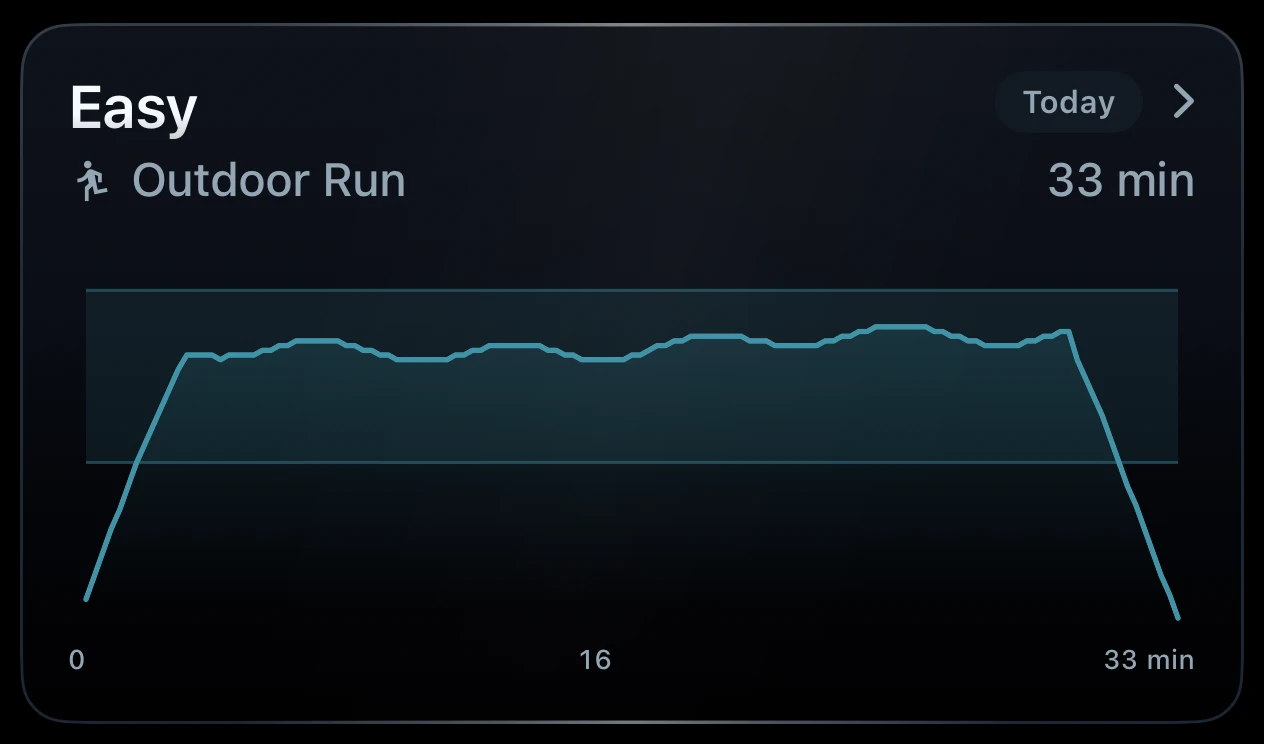
The study's range of 90 to 95% of max crosses the 92% line where Diastra's VO₂max band starts. Type your age below to see each band as a heart rate. Easy on the card is the Zone 2 most runners know.
Find your heart rate zones
Type your age. Add your sex and a max you have seen if you know them. The example below is a 35-year-old.
Age 35 · max heart rate 208 − 0.7 × 35 = 184, an estimate
Your Easy band, your Zone 2111 to 146beats a minute
Your Easy band runs 16 beats higher than the common Zone 2 chart lets you go.
Max from age uses Tanaka’s formula (208 − 0.7 × age). Easy ends where blood tests find lactate starting to rise, which is higher for women than for men. What you type stays on this page.
Diastra reads your max from your own Apple Watch workouts or a guided test and draws your bands from it.
Start my free trialGive a block of training about 8 weeks before you check your place again. A 2019 study had 39 adults who had been doing little exercise train three days a week[7]. One group's VO₂max went from 24.3 at the start to 24.7 at week 4 and 25.9 at week 8. The rise was clear at week 8 and too small to be sure of at week 4[7].
The guide on how to improve VO₂max covers how hard, how often and how long to train.
What does Diastra do with this?
Diastra reads every workout your Apple Watch saved in Apple Health. It finds your max heart rate in those workouts and draws your Easy, Threshold and VO₂max bands from that max. The watch taps your wrist when you drift out of your band, and only the minutes that held are credited. Over the weeks Diastra shows whether your training is working. Getting fitter. Holding steady. Slipping.
See your own bands from your own workouts.
Diastra reads every workout your Apple Watch saved, finds your real max heart rate and draws Easy, Threshold and VO₂max from it. Then it holds you in your band on every run and shows you over the weeks whether your training is working.
Start my free trial$119 a year, or $19.99 a month. Seven days free. For iPhone and Apple Watch.
More questions
Why did my percentile change when I turned 40?
The registry groups people by decade, so the birthday that starts a new decade moves you to a new row. A man of 39 with a VO₂max of 43.4 is at the 60th percentile for his row[1]. At 40 the same number lands at about the 76th, because the men in their 40s scored lower as a group. Your fitness stayed the same and the group you are compared with changed.
Why does the calculator need my sex?
The registry printed one table for men and one for women[1]. One number can land far apart on the two tables. A VO₂max of 35 lands at about the 34th percentile for a man in his 30s. The same 35 lands at about the 74th for a woman in her 30s.
Why does another calculator give me a different percentile?
Charts are built from different tests. The FRIEND registry's first treadmill tables from 2015 ran 1.5 to 4.6 mL/kg/min higher than the 2022 ones[1]. A chart built on the 2015 table places the same number lower. Some charts sort you into a few broad groups, and this calculator draws a straight line between the registry's printed points.
Is the 50th percentile the same as the average?
The 50th percentile is the middle of the group. Half the people tested scored above it and half scored below it. An average adds up every score and divides, so the two can differ. For men in their 40s the 50th percentile is 35.3, and for women in their 40s it is 25.7[1].
Does the same gain move everyone the same amount?
A gain of the same size moves you further in the older rows, because the cut points there are closer together. A man in his 20s at the 50th percentile has a VO₂max of 46.5, and 2 more points takes him to about the 58th. A man in his 60s at the 50th has 24.6, and 2 more points takes him to about the 60th[1].
Sources
- Kaminsky LA, Arena R, Myers J, Peterman JE, Bonikowske AR, Harber MP, Medina Inojosa JR, Lavie CJ, Squires RW. 2022. Updated reference standards for cardiorespiratory fitness measured with cardiopulmonary exercise testing. Data from the Fitness Registry and the Importance of Exercise National Database (FRIEND). Mayo Clin Proc 97(2):285-293.The registry pooled 22,379 lab tests of healthy adults aged 20 to 89 from 34 labs across the United States. Of those, 16,278 were treadmill tests, and the paper gives VO₂max percentiles by sex for each decade of age. The treadmill values came out 1.5 to 4.6 points lower than the registry's 2015 tables.
- Lambe R, Schumann M, Donnelly L, Hamilton S, Lally S, Rafter E, O'Reilly S, White T, Doherty C. 2026. Accuracy of VO2 max Estimates From Apple Watch Series 10. Mayo Clin Proc Digit Health 4(2):100357.35 adults who averaged 23 years old wore a Series 10 and ran a lab treadmill test. The watch read 6.25 points lower on average, and its average miss either way was 6.79 points. It put 5 of the 35 in the same FRIEND percentile band as the lab.
- Apple. May 2021. Using Apple Watch to Estimate Cardio Fitness with VO2 max. Apple white paper. Read October 7, 2026.Apple's paper says the watch estimates VO₂max from how your heart rate responds to physical activity.
- Apple Support. Track your cardio fitness levels. Published September 14, 2026. Read October 7, 2026.Apple Watch Series 3 or later estimates VO₂max during Outdoor Walk, Outdoor Run and Hiking workouts, and indoor workouts are left out of the estimate.
- Milanović Z, Sporiš G, Weston M. 2015. Effectiveness of high-intensity interval training (HIT) and continuous endurance training for VO2max improvements. A systematic review and meta-analysis of controlled trials. Sports Med 45(10):1469-1481.The review pooled 28 studies with 723 adults who averaged 25 years old and started at 40.8. Steady endurance training raised VO₂max 4.9 mL/kg/min more than no training, and interval training raised it 5.5 more.
- Helgerud J, Høydal K, Wang E, Karlsen T, Berg P, Bjerkaas M, Simonsen T, Helgesen C, Hjorth N, Bach R, Hoff J. 2007. Aerobic high-intensity intervals improve VO2max more than moderate training. Med Sci Sports Exerc 39(4):665-671.40 moderately trained men were split into four groups that trained three days a week for 8 weeks with the same total work. The group that ran four 4-minute intervals at 90 to 95% of max heart rate raised VO₂max from 55.5 to 60.4, a gain of 7.2%, which was more than the groups that ran at a steady 70% or 85% of max.
- Weatherwax R, Harris N, Kilding AE, Dalleck L. 2019. Time course changes in confirmed 'true' VO2max after individualized and standardized training. Sports Med Int Open 3(2):E32-E39.39 adults who had been doing little exercise trained three days a week for 12 weeks. In one group VO₂max went from 24.3 to 24.7 at week 4 and 25.9 at week 8, and the rise was clear from week 8.
- Murias JM, Kowalchuk JM, Paterson DH. 2010. Time course and mechanisms of adaptations in cardiorespiratory fitness with endurance training in older and young men. J Appl Physiol 108(3):621-627.8 men who averaged 68 years old and 8 who averaged 23 cycled 45 minutes three times a week. After 12 weeks VO₂max had risen 31% in the older men and 18% in the young men.