 Diastra
 VO₂max · Part 1 of 6
VO₂max by age for men and women
VO₂max is the most oxygen your body can use in one minute of all-out effort for each kilogram you weigh. Lab treadmill tests of healthy American adults put the 50th percentile at 46.5 mL/kg/min for men and 36.6 for women in their 20s, and it falls to 24.6 for men and 19.6 for women in their 60s.
On this page
- What is VO₂max?
- What does VO₂max look like at your age?
- How do you read your own number on the chart?
- How is VO₂max measured in a lab?
- How does Apple Watch estimate VO₂max?
- How fast does VO₂max drop with age?
- Does training slow the drop?
- What raises VO₂max?
- What does Diastra do with this?
- More questions
- Sources
What is VO₂max?
VO₂max is your aerobic capacity. It is the most oxygen your body can use in one minute when you go all-out. Your heart pumps blood to your muscles, and your muscles pull oxygen out of that blood. VO₂max sums up both jobs at full effort.
The number is written in mL/kg/min. That means milliliters of oxygen per minute for each kilogram you weigh. A lab first measures the total oxygen your body uses in a minute. Then it divides that total by your weight.
Here is an example. A runner who weighs 70 kilograms uses 3.5 liters of oxygen a minute at full effort. That is 3,500 milliliters. 3,500 divided by 70 is 50, so this runner's VO₂max is 50 mL/kg/min.
Dividing by weight lets a small runner and a large runner be compared on one scale. It also means two people with the same heart and lungs can score differently if they weigh differently.
What does VO₂max look like at your age?
A large set of lab-measured VO₂max values in the United States comes from the FRIEND registry. FRIEND stands for the Fitness Registry and the Importance of Exercise National Database. Its 2022 update pooled 22,379 tests of healthy adults aged 20 to 89 from 34 labs[1]. Each person ran on a treadmill or rode a bike until they could not go on. A mask measured the air they breathed the whole time.
The tables below use only the 16,278 treadmill tests. A treadmill test is the closest match for a runner. The registry used a test only when the breathing data met a rule for an all-out effort[1].
A percentile tells you where a score lands in its group. At the 50th percentile, half the group scored higher and half scored lower. At the 90th percentile, nine in ten people scored lower.
Men, treadmill tests, FRIEND 2022
Each column is a percentile. Each cell is VO₂max in mL/kg/min[1].
| Age | 90th | 80th | 70th | 60th | 50th | 40th | 30th | 20th | 10th |
|---|---|---|---|---|---|---|---|---|---|
| 20 to 29 | 58.6 | 54.5 | 51.9 | 49.0 | 46.5 | 43.6 | 40.0 | 35.2 | 28.6 |
| 30 to 39 | 55.5 | 50.0 | 46.4 | 43.4 | 39.7 | 37.0 | 33.5 | 29.8 | 24.9 |
| 40 to 49 | 50.8 | 45.2 | 40.9 | 37.9 | 35.3 | 32.4 | 29.7 | 26.7 | 22.1 |
| 50 to 59 | 43.4 | 38.3 | 34.3 | 31.8 | 29.2 | 26.9 | 24.5 | 22.2 | 18.6 |
| 60 to 69 | 37.1 | 32.0 | 28.7 | 26.5 | 24.6 | 22.8 | 20.7 | 18.5 | 15.8 |
| 70 to 79 | 29.4 | 25.9 | 23.8 | 22.2 | 20.6 | 19.1 | 17.3 | 15.9 | 13.6 |
| 80 to 89 | 22.8 | 21.4 | 20.0 | 18.4 | 17.6 | 16.6 | 16.1 | 14.8 | 12.9 |
Women, treadmill tests, FRIEND 2022
Each column is a percentile. Each cell is VO₂max in mL/kg/min[1].
| Age | 90th | 80th | 70th | 60th | 50th | 40th | 30th | 20th | 10th |
|---|---|---|---|---|---|---|---|---|---|
| 20 to 29 | 49.0 | 44.8 | 41.8 | 39.0 | 36.6 | 34.0 | 30.8 | 27.2 | 22.5 |
| 30 to 39 | 42.1 | 37.0 | 33.6 | 31.0 | 28.3 | 26.4 | 24.2 | 21.9 | 18.6 |
| 40 to 49 | 37.8 | 33.0 | 30.0 | 27.7 | 25.7 | 23.9 | 21.8 | 19.7 | 17.2 |
| 50 to 59 | 32.4 | 28.4 | 26.3 | 24.6 | 22.9 | 21.5 | 20.1 | 18.5 | 16.5 |
| 60 to 69 | 27.3 | 24.3 | 22.4 | 20.9 | 19.6 | 18.3 | 17.0 | 15.4 | 13.4 |
| 70 to 79 | 22.8 | 20.8 | 19.6 | 18.3 | 17.2 | 16.2 | 15.2 | 14.0 | 12.3 |
| 80 to 89 | 20.8 | 18.4 | 17.3 | 16.0 | 15.4 | 14.7 | 13.7 | 12.6 | 11.4 |
The same registry published its first tables in 2015. The 2022 treadmill values came out 1.5 to 4.6 points lower than the 2015 ones[1]. A chart that still quotes the 2015 table shows higher numbers for the same percentile.
How do you read your own number on the chart?
Find the row for your age and sex. Then find the two columns your number lands between. A 35-year-old woman with a VO₂max of 33 lands between the 60th percentile and the 70th. Her row reads 31.0 and 33.6 there.
Three things decide how much that spot can tell you.
- The chart is a snapshot. Each row is a different group of people who were tested once. It compares people of different ages, and it does not follow anyone over time.
- A lab number and a watch number are different measurements. The chart comes from masks and treadmills. A watch gives an estimate, and the sections below show how far it can miss.
- Treadmill and bike tests have separate tables. The FRIEND registry keeps its bike tests in their own table. Read a number against the table for the test that made it.
How is VO₂max measured in a lab?
A lab treadmill test is a run that gets harder in steps until you cannot continue. The treadmill speeds up or tilts up at each step. You wear a mask, and a machine measures the oxygen in the air you breathe in and out. The difference is the oxygen your body used.
The oxygen you use usually levels off near the end even as the work keeps rising[2]. The highest value the machine records is your VO₂max. Some labs call it VO₂peak, because nobody can be sure the true maximum was reached. This page uses VO₂max for both.
How does Apple Watch estimate VO₂max?
Apple Watch calls its estimate Cardio Fitness. Apple Watch Series 3 or later records it during an Outdoor Walk, Outdoor Run or Hiking workout[3]. Indoor workouts are left out of the estimate. The watch reads how hard your heart works for the effort you put in. It also uses your age, sex, weight and height[3]. Apple's paper lists the heart sensor, the motion sensors and GPS among the data it used to build the estimate[2].
Apple compared the watch with a lab reference in 221 people who averaged 55 years old[2]. Apple built that reference from the easier stages of each lab test and projected it up to a maximum. On average the watch read 1.4 mL/kg/min higher than the reference, and the spread around that average was 4.7[2]. So one person's estimate can land several points away from a lab result.
An independent study in 2025 tested Apple Watch in 30 adults who averaged 32 years old[4]. Each person also ran a lab treadmill test to exhaustion, and 28 of them met the rules for a true all-out effort. For those 28 people the lab average was 49.4 mL/kg/min and the watch average was 43.3. The watch read 6.1 lower than the lab on average, and the typical miss was 13.3% of the lab value[4].
Read a watch number against the chart as a rough guide to where you land. Apple Watch VO₂max accuracy explains how far the watch can miss and why. What the watch's Cardio Fitness screen shows is in cardio fitness on Apple Watch.
How fast does VO₂max drop with age?
The chart shows the drop across age groups. At the 50th percentile, men go from 46.5 in their 20s to 35.3 in their 40s and 24.6 in their 60s. Women go from 36.6 to 25.7 and then 19.6[1]. The treadmill values fell by an average of 13.5% with each decade of age from the 20s to the 80s. That is about 4.0 mL/kg/min each decade[1].
That chart compares different people at different ages. A study that tests the same people over time gives a cleaner answer. The Baltimore Longitudinal Study of Aging tested 810 healthy adults aged 21 to 87 over a median of 7.9 years[5].
VO₂max fell 3% to 6% per decade in people in their 20s and 30s. The drop sped up with age. People in their 70s and older lost more than 20% per decade. Men lost more than women from their 40s on[5].
Max heart rate fell 4% to 6% per decade in the same study, and that rate sped up only a little with age. The oxygen the body used with each heartbeat fell at the same rate as VO₂max itself[5].
Does training slow the drop?
In one long study, the men who kept training hard lost VO₂max more slowly. The study tested 53 men who had been elite distance runners in the late 1960s and early 1970s. Researchers tested them again about 22 years later[6].
The 10 men who still trained hard lost about 6% per decade. Their average went from 68.8 to 59.2 mL/kg/min. The men who no longer trained lost about 15% per decade. Their average fell from 70.7 to 46.7. Men who kept a lighter fitness routine lost about 10% per decade[6].
The same study tested 10 older men who averaged 68 years old. They kept training and still lost about 15% per decade[6]. Every group lost some VO₂max, including the men who trained hard.
The Baltimore study found similar rates of decline at every level of leisure exercise that people reported[5]. Those were habits people described in a survey. The runners study measured men who kept training hard for two decades.
Men who trained for life also stand out in their 80s. Nine men in their 80s with a lifetime of endurance training averaged a VO₂max of 38 mL/kg/min. Six untrained men the same age averaged 21[7]. The authors knew of no one over 80 with a higher VO₂max. These men did a bike test, so their numbers do not line up with the treadmill chart above.
The FRIEND chart shows how wide each age group is. A man at the 90th percentile in his 60s scores 37.1. That beats the 35.3 of a man at the 50th percentile in his 40s. For women the same comparison is 27.3 against 25.7[1].
What raises VO₂max?
Training raises VO₂max. One well-known study had moderately trained men run four 4-minute intervals at 90 to 95% of max heart rate three times a week. Their VO₂max rose 7.2% in 8 weeks[8].
The card below turns those percentages into heart rates for your age. Diastra's VO₂max band starts at 92% of max.
Find your heart rate zones
Type your age. Add your sex and a max you have seen if you know them. The example below is a 35-year-old.
Age 35 · max heart rate 208 − 0.7 × 35 = 184, an estimate
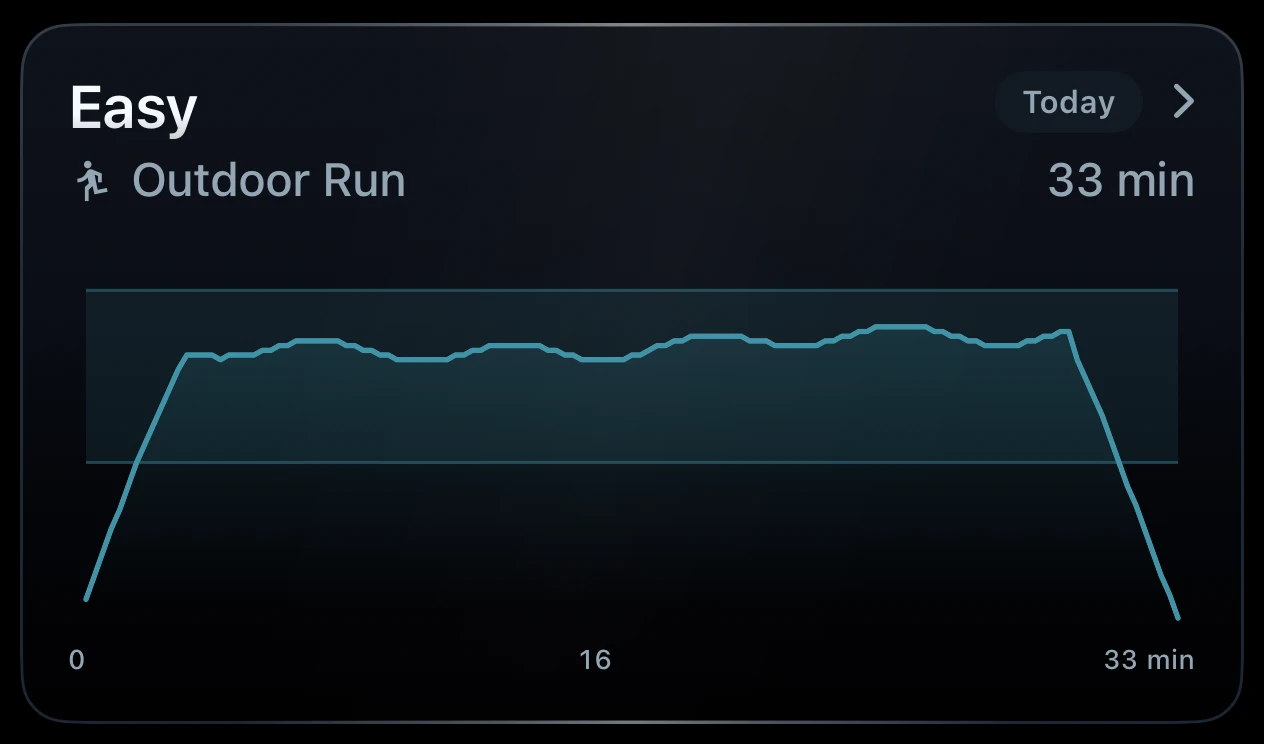
Your Easy band, your Zone 2111 to 146beats a minute
Your Easy band runs 16 beats higher than the common Zone 2 chart lets you go.
Max from age uses Tanaka’s formula (208 − 0.7 × age). Easy ends where blood tests find lactate starting to rise, which is higher for women than for men. What you type stays on this page.
Diastra reads your max from your own Apple Watch workouts or a guided test and draws your bands from it.
Start my free trialThe research on how hard, how often and how long is in how to improve VO₂max. The Norwegian 4x4 workout walks through the session from that study step by step.
What does Diastra do with this?
Diastra reads every workout your Apple Watch saved in Apple Health. It finds your max heart rate in those workouts and draws your Easy, Threshold and VO₂max bands from it. Then it builds a weekly plan around those bands and shows you over the weeks whether your training is working.
See your own bands from your own workouts.
Diastra reads every workout your Apple Watch saved, finds your real max heart rate and draws Easy, Threshold and VO₂max from it. Then it holds you in your band on every run and shows you over the weeks whether your training is working.
Start my free trial$119 a year, or $19.99 a month. Seven days free. For iPhone and Apple Watch.
More questions
Do women and men use the same VO₂max chart?
Each sex has its own chart. In the FRIEND registry, the 50th percentile for men was higher than for women in every age group[1]. The two charts overlap at the top. A woman in her 20s at the 90th percentile scores 49.0, which is above the 46.5 of a man in his 20s at the 50th.
Does losing weight raise VO₂max?
VO₂max is divided by body weight, so a lighter body gives a higher number when the total oxygen stays the same. A runner who uses 3,500 milliliters of oxygen a minute scores 50 at 70 kilograms. The same runner scores about 54 at 65 kilograms. The heart and the muscles did the same work both times.
What range of VO₂max can Apple Watch show?
Apple Watch reports Cardio Fitness from 14 to 65 mL/kg/min[3]. It makes the estimate during an Outdoor Walk, Outdoor Run or Hiking workout. Apple shows its fitness levels to people aged 20 and older.
Where does a VO₂max of 40 land?
It depends on your age and sex. For a man in his 20s, 40.0 is the 30th percentile. For a man in his 40s, the 70th percentile is 40.9, so 40 lands a little under it. For a woman in her 40s, 40 is above the 90th percentile of 37.8[1].
Sources
- Kaminsky LA, Arena R, Myers J, Peterman JE, Bonikowske AR, Harber MP, Medina Inojosa JR, Lavie CJ, Squires RW. 2022. Updated reference standards for cardiorespiratory fitness measured with cardiopulmonary exercise testing. Data from the Fitness Registry and the Importance of Exercise National Database (FRIEND). Mayo Clin Proc 97(2):285-293.22,379 lab tests of healthy adults aged 20 to 89 from 34 labs across the United States, 16,278 of them on a treadmill, with VO₂max percentiles by age and sex. The treadmill values came out 1.5 to 4.6 points lower than the registry's 2015 tables.
- Apple. May 2021. Using Apple Watch to Estimate Cardio Fitness with VO2 max. Apple white paper. Read October 4, 2026.Apple compared its estimate with a lab reference in 221 people who averaged 55 years old. The reference was projected up from the easier stages of each lab test. The watch read 1.4 mL/kg/min higher on average, with a spread of 4.7.
- Apple Support. Track your cardio fitness levels. Published September 14, 2026. Read October 4, 2026.Apple Watch Series 3 or later estimates VO₂max during outdoor walks, runs and hikes, from 14 to 65 mL/kg/min, with levels shown from age 20. Apple Watch leaves indoor workouts out of the estimate.
- Lambe R, O'Grady B, Baldwin M, Doherty C. 2025. Investigating the accuracy of Apple Watch VO2 max measurements: A validation study. PLoS One 20(5):e0323741.30 adults with an average age of 32 wore Apple Watch and then ran a lab treadmill test, and 28 of them met the rules for an all-out effort. The watch read 6.1 mL/kg/min lower on average, with a typical miss of 13.3%.
- Fleg JL, Morrell CH, Bos AG, Brant LJ, Talbot LA, Wright JG, Lakatta EG. 2005. Accelerated longitudinal decline of aerobic capacity in healthy older adults. Circulation 112(5):674-682.810 healthy adults aged 21 to 87 were tested again over a median of 7.9 years. The drop grew from 3% to 6% per decade in the 20s and 30s to more than 20% per decade in the 70s and older.
- Trappe SW, Costill DL, Vukovich MD, Jones J, Melham T. 1996. Aging among elite distance runners. A 22-yr longitudinal study. J Appl Physiol 80(1):285-290.53 former elite runners were tested again after about 22 years. The men who kept training hard lost about 6% per decade. The men who no longer trained, and the older men who kept training, lost about 15%.
- Trappe S, Hayes E, Galpin A, Kaminsky L, Jemiolo B, Fink W, Trappe T, Jansson A, Gustafsson T, Tesch P. 2013. New records in aerobic power among octogenarian lifelong endurance athletes. J Appl Physiol 114(1):3-10.Nine men in their 80s with a lifetime of endurance training averaged a VO₂max of 38 mL/kg/min on a bike test, against 21 for six untrained men their age.
- Helgerud J, Høydal K, Wang E, Karlsen T, Berg P, Bjerkaas M, Simonsen T, Helgesen C, Hjorth N, Bach R, Hoff J. 2007. Aerobic high-intensity intervals improve VO2max more than moderate training. Med Sci Sports Exerc 39(4):665-671.40 moderately trained men. Four 4-minute intervals at 90 to 95% of max, three times a week, raised VO₂max 7.2% in 8 weeks.