 Diastra
 VO₂max · Part 6 of 6
The Cooper test, a 12-minute run for VO₂max
The Cooper test is a fitness benchmark where you run as far as you can in 12 minutes. The distance goes into an equation for VO₂max, and 2,400 meters works out to about 42.4 mL/kg/min.
On this page
- What is the Cooper test?
- How do you run the Cooper test?
- How do you turn your distance into VO₂max?
- How close does a 12-minute run get to a lab test?
- What changes your distance from one test to the next?
- What else can your 12-minute distance tell you?
- What is a good Cooper test score?
- Does the Cooper test show your max heart rate?
- Where Diastra fits
- More questions
- Sources
What is the Cooper test?
Kenneth Cooper published the 12-minute run in JAMA in 1968.[1] He tested 115 United States Air Force men in two ways. Each man ran as far as he could in 12 minutes. Each man also ran a treadmill test in a lab that measured the most oxygen he could use.
The test asks one thing of you. Run as far as you can in 12 minutes. The distance goes into an equation, and out comes an estimate of your VO₂max. VO₂max is your aerobic capacity, the most oxygen your body can use when you go all-out.
The Cooper test is a fitness benchmark. It is an all-out effort, so pick a day when you feel fresh and your legs are rested.
How do you run the Cooper test?
- Go to a 400-meter track if you can. Open sky and flat ground give the cleanest distance, and you can count your own laps as a check.
- Warm up with easy jogging until your legs feel loose. Finish with a few short bursts of faster running so your legs are ready to run hard.
- Start an outdoor run on your watch and a 12-minute timer.
- Run as far as you can in 12 minutes. Hold one even pace and use whatever you have left in the last minute.
- Stop when the timer ends and note the spot. Add your full laps to the part of the last lap.
- Jog or walk easy for a few minutes to cool down.
Pacing decides the result. A fast first lap that you cannot hold usually ends with a shorter distance than an even run.
A few things make the distance wrong. A net downhill or a strong tailwind adds distance that does not come from your fitness. Tall buildings, heavy tree cover and tunnels make GPS drift. A track avoids most of these, because the laps are a fixed length.
How do you turn your distance into VO₂max?
This is the line researchers call Cooper's equation, and you can run it yourself on your own distance.[2]
VO₂max = 22.351 × distance in kilometers − 11.288
The answer comes out in mL/kg/min. That means milliliters of oxygen for each kilogram of body weight each minute. If you measured in miles, the same line reads 35.970 × miles − 11.288.
Here is one worked example. Say you ran six laps of a 400-meter track, which is 2,400 meters.
- 2,400 meters is 2.4 kilometers.
- 22.351 × 2.4 = 53.6424.
- 53.6424 − 11.288 = 42.3544.
- Your estimate is about 42.4 mL/kg/min.
Every 45 meters of distance moves the estimate by about one point, because 1,000 divided by 22.351 is 44.7. That is why a track helps. GPS drift of half a lap can move the answer by about four and a half points.
| Distance in 12 minutes | Laps of a 400-meter track | Estimated VO₂max (mL/kg/min) |
|---|---|---|
| 2,000 meters | 5 | 33.4 |
| 2,400 meters | 6 | 42.4 |
| 2,800 meters | 7 | 51.3 |
| 3,200 meters | 8 | 60.2 |
A distance far from what your usual pace would give often points to a GPS problem or a stopped workout. Check the route before you trust the number.
How close does a 12-minute run get to a lab test?
Cooper's own result was strong. The 12-minute distance and the lab result in his 115 Air Force men had a correlation of 0.897.[1] A correlation of 1 would mean the two always rise and fall together. A correlation of 0 would mean no link at all.
Later studies found a looser link. A 2016 review pooled 26 results from 1,204 people. The 12-minute test scored 0.78 against lab tests.[3] That was the highest score of the tests in the review that run for a set time. Sex, age and fitness level did not seem to change how well these tests worked. The authors remind readers that a field test gives an estimate. Only a lab test measures VO₂max directly.
Single studies found the estimate landing above the lab number in some groups and below it in others.
- The Cooper estimate averaged 60.6 mL/kg/min in 22 young men who exercised regularly. Their lab treadmill test averaged 60.1.[4]
- The estimate averaged 6.0 points below a lab treadmill test in 73 college team-sport athletes. Nearly every athlete landed somewhere between 19.8 points below and 7.9 points above.[5]
- The estimate averaged 3.0 points above a lab test on a bike in 58 inactive male students.[2]
- A study of 21 young adults found the estimate read low for people with lower lab results and high for people with higher ones.[6]
So the line puts a group of people in about the right order. One person's number can still miss by several points in either direction. Your number is most useful when you compare it with your own next test on the same track.
What changes your distance from one test to the next?
Repeat tests agree closely when nothing else changes. One study had 60 young adults do the 12-minute run three times and a shuttle run test three times. The repeat results lined up closely across both tests. Their reliability score was 0.96 out of 1.[6]
Sleep moves the distance. Twenty young runners did a 12-minute run after a full night of 8 hours in bed and again after only 4 hours. They covered about 6% less distance after the short night.[7] Six percent of 2,400 meters is about 144 meters. That moves the estimate by more than three points.
Keep the conditions the same each time. Use the same track, a similar time of day and a similar training day before it. Then a longer distance is more likely to mean you got fitter.
VO₂max takes weeks to move. Clear gains showed up by the end of 8 weeks of training in the study behind the Norwegian 4x4 workout.[8] A second test after about 8 weeks of regular training gives a real change time to show.
What else can your 12-minute distance tell you?
A Cooper distance also tracks race times. One study followed 198 recreational runners who ran the Cooper test 7 to 10 days before a half marathon.[9] A longer Cooper distance went with a faster half marathon. The correlation was minus 0.906. The minus sign only means that more meters went with fewer minutes.
The same study built an equation from the test. It predicted half-marathon time with a typical error of about 5 minutes. Most of the runners in that study were men around 40 years old.[9]
What is a good Cooper test score?
A good Cooper score is one that beats your own last test on the same track. A longer distance after a block of training is a clear sign that your training is working.
Many charts online turn a 12-minute distance into a grade word for your age and sex. A grade word hides the number. The number is what you compare the next time you run the test.
One test is one point on a line. It tells you where you are today. A second test after weeks of training tells you which way you are moving.
The VO₂max by age guide shows where your number lands among people of your age and sex who took a lab test.
Does the Cooper test show your max heart rate?
The finish gives you a floor for your max. Push the last minute as hard as you can, and the top heart rate near the finish is a measured number. Your max heart rate is at least that high.
That number is a better starting point than a guess from your age. A study of 3,320 healthy adults found that a max predicted from age alone had a typical error of about 11 beats a minute.[10]
A hard finish can reach as high as a lab test does. One study of 104 adults found the top heart rate in the 12-minute run averaged about 184 beats a minute. The same people averaged about 180 in a lab treadmill test.[11] That lab test could stop before a person reached their highest heart rate, so neither average is sure to be a true max.
Your true max can still be higher than the peak you saw. One peak only shows how high your heart rate went that day. Type the peak from your finish as your max below, and the bands redraw from a measured number.
Find your heart rate zones
Type your age. Add your sex and a max you have seen if you know them. The example below is a 35-year-old.
Age 35 · max heart rate 208 − 0.7 × 35 = 184, an estimate
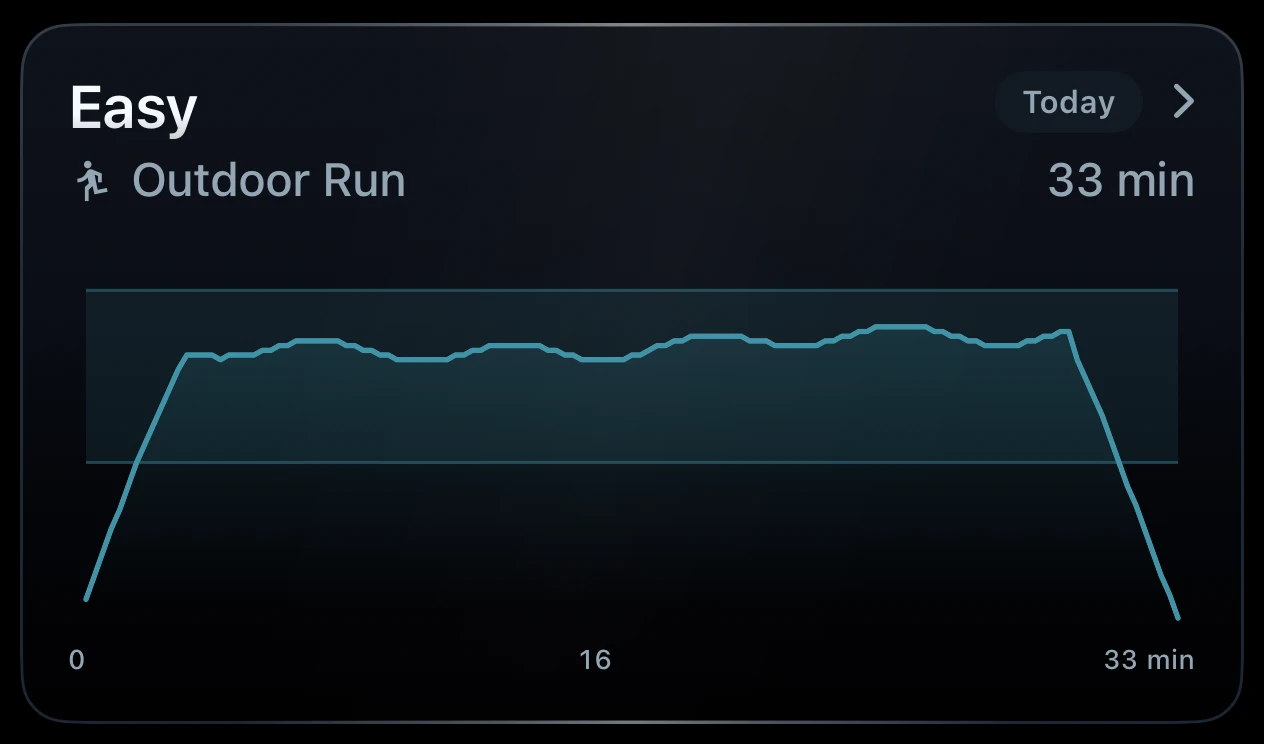
Your Easy band, your Zone 2111 to 146beats a minute
Your Easy band runs 16 beats higher than the common Zone 2 chart lets you go.
Max from age uses Tanaka’s formula (208 − 0.7 × age). Easy ends where blood tests find lactate starting to rise, which is higher for women than for men. What you type stays on this page.
Diastra reads your max from your own Apple Watch workouts or a guided test and draws your bands from it.
Start my free trialThe guide to finding your max heart rate covers more ways to find it, and how to read the peak your watch saved.
Where Diastra fits
Diastra reads every workout your Apple Watch saved. It finds your max heart rate from your own workouts, a guided max heart rate test or a number you type, and it tells you which one it used. Easy, Threshold and VO₂max are drawn from that max. Diastra also shows over the weeks whether your training is working ("Getting fitter. Holding steady. Slipping."), even when the answer is no.
See your own bands from your own workouts.
Diastra reads every workout your Apple Watch saved, finds your real max heart rate and draws Easy, Threshold and VO₂max from it. Then it holds you in your band on every run and shows you over the weeks whether your training is working.
Start my free trial$119 a year, or $19.99 a month. Seven days free. For iPhone and Apple Watch.
More questions
Can you do the Cooper test on a treadmill?
Run it outside if you can. Indoors there is no GPS signal, so a watch estimates the distance instead of measuring it. An estimate is too loose for a test where 45 meters moves the result by a full point. If a treadmill is your only option, use the distance on the treadmill's own display and test on the same machine every time.
Is the Cooper test the same as Cardio Fitness on Apple Watch?
They are two different estimates. The Cooper test works from one all-out distance on a day you choose. Cardio Fitness is the watch's own estimate, and this guide explains how it works. This one covers how far it can be off.
What if I have to walk part of it?
The equation uses the distance no matter how you covered it. Walk when you need to and run again when you can. Your next test still compares well with this one if you run it the same way.
Sources
- Cooper KH. 1968. A means of assessing maximal oxygen intake. Correlation between field and treadmill testing. JAMA 203(3):201-204.The original 12-minute run. In 115 US Air Force men, the 12-minute distance and a lab treadmill test of oxygen use had a correlation of 0.897.
- Bandyopadhyay A. 2015. Validity of Cooper's 12-minute run test for estimation of maximum oxygen uptake in male university students. Biol Sport 32(1):59-63.Prints Cooper's equation as 22.351 times kilometers minus 11.288. In 58 inactive male students it averaged 42.8 against 39.8 measured on a lab bike.
- Mayorga-Vega D, Bocanegra-Parrilla R, Ornelas M, Viciana J. 2016. Criterion-related validity of the distance- and time-based walk/run field tests for estimating cardiorespiratory fitness: a systematic review and meta-analysis. PLoS One 11(3):e0151671.Pooled 26 results from 1,204 people. The 12-minute test scored 0.78 against lab VO₂max, the highest of the tests that run for a set time.
- Grant S, Corbett K, Amjad AM, Wilson J, Aitchison T. 1995. A comparison of methods of predicting maximum oxygen uptake. Br J Sports Med 29(3):147-152.In 22 young men who exercised regularly, the Cooper test averaged 60.6 mL/kg/min against 60.1 on a lab treadmill.
- Soares EM, Silva R, da Cruz CJ, Porto LG, Fontana KE, Molina GE, Kobayashi L. 2026. Cooper's 12 minute run systematically underestimates VO2max in collegiate team sport athletes: validity and classification accuracy. Int J Exerc Sci 19(2):2012.In 73 college team-sport athletes, the 12-minute run averaged 6.0 mL/kg/min below a lab treadmill test, and nearly all single gaps fell between 19.8 below and 7.9 above.
- Penry JT, Wilcox AR, Yun J. 2011. Validity and reliability analysis of Cooper's 12-minute run and the multistage shuttle run in healthy adults. J Strength Cond Res 25(3):597-605.Sixty young adults ran each field test three times, and repeat results agreed closely (0.96). In the 21 with a lab test, the 12-minute run read low at lower values and high at higher ones.
- Souissi W, Hammouda O, Ayachi M, Ammar A, Khcharem A, de Marco G, Souissi M, Driss T. 2020. Partial sleep deprivation affects endurance performance and psychophysiological responses during 12-minute self-paced running exercise. Physiol Behav 227:113165.Twenty young runners covered about 6% less distance in a 12-minute run after 4 hours in bed than after 8.
- Helgerud J, Høydal K, Wang E, Karlsen T, Berg P, Bjerkaas M, Simonsen T, Helgesen C, Hjorth N, Bach R, Hoff J. 2007. Aerobic high-intensity intervals improve VO2max more than moderate training. Med Sci Sports Exerc 39(4):665-671.Moderately trained men who ran the 4x4 three times a week raised VO₂max 7.2% in 8 weeks.
- Alvero-Cruz JR, Standley RA, Giráldez-García MA, Carnero EA. 2020. A simple equation to estimate half-marathon race time from the Cooper test. Int J Sports Physiol Perform 15(5):690-695.In 198 recreational runners, Cooper distance tracked half-marathon time closely (r = -0.906), and an equation built from it had a standard error of 5.19 minutes.
- Nes BM, Janszky I, Wisløff U, Støylen A, Karlsen T. 2013. Age-predicted maximal heart rate in healthy subjects: The HUNT fitness study. Scand J Med Sci Sports 23(6):697-704.Measured max heart rate in 3,320 healthy adults. A max predicted from age alone had a standard error of 10.8 beats a minute.
- Lee K, Kim D, Shin S, Choi H, Jang A, Chung J. 2025. Smartwatch-derived VO2max prediction model for Korean adults: utilizing heart rate and GPS data from the 12-minute Cooper test. Healthcare (Basel) 13(7):722.In 104 adults, a watch read the top heart rate in the 12-minute run at 183.9 beats a minute on average, against 180.5 in a lab treadmill test.