 Diastra
 VO₂max · Part 4 of 6
What is Cardio Fitness on Apple Watch?
Cardio Fitness is Apple's name for the VO₂max estimate your Apple Watch makes during outdoor walks, runs and hikes. Open the Health app on iPhone and tap Browse, then Heart, then Cardio Fitness to see your number and Apple's level for your age and sex.
On this page
- What does Cardio Fitness measure?
- Where do you find Cardio Fitness on iPhone?
- What do the Cardio Fitness levels mean?
- Why is Cardio Fitness not showing yet?
- How do you help the watch make a good estimate?
- How do you raise your Cardio Fitness with training?
- How long does it take for Cardio Fitness to change?
- More questions
- Sources
What does Cardio Fitness measure?
Cardio Fitness is Apple's estimate of your VO₂max. VO₂max is your aerobic capacity. It is the most oxygen your body can use when you go all-out. It is measured in milliliters of oxygen for each kilogram of body weight each minute. You will see it written as mL/kg/min. This page calls one of those units a point.
A lab measures VO₂max with an exercise test and a mask. Apple Watch estimates it during three kinds of workout. They are Outdoor Walk, Outdoor Run and Hiking[1]. Apple's paper says the watch measures how your heart rate responds to the work of walking, running or hiking outdoors[2]. The watch adds GPS data such as your speed, distance and climb[5].
The watch also uses details you enter in the Health app, such as your age, sex, weight and height[1].
Apple Watch can take a reading outside a workout too. The watch has been able to measure Cardio Fitness during everyday outdoor walks since watchOS 7[3][2].
Where do you find Cardio Fitness on iPhone?
Apple's support page gives these steps[1].
- Open the Health app.
- Tap the Browse tab.
- Tap Heart, then tap Cardio Fitness.
- Tap D, W, M, 6M or Y to see your average for a day, a week, a month, six months or a year.
- Tap Show All Cardio Fitness Levels.
- Tap a level to compare your results with the other levels for your age and sex.
The six month and year views show the longer trend. One reading tells you little on its own.
What do the Cardio Fitness levels mean?
Apple sorts each estimate into one of four levels. Apple names them High, Above Average, Below Average and Low[3]. Each level compares your estimate with people of your sex in your age group. Apple bases those comparisons on a national registry of lab fitness tests. Its full name is the Fitness Registry and the Importance of Exercise National Database, or FRIEND[3].
A level is a place in a crowd. It shows where your estimate lands among people like you. Your own trend is a separate question, and the chart over months answers it.
Moving into a new age group means a new comparison. The guide to VO₂max by age shows how the numbers shift from one age group to the next.
The level also depends on the estimate under it. Three lab studies outside Apple found that the watch read 4.5 to 6.3 points lower than a lab test on average[7][6][5]. The fittest group in the Series 10 study read 7.8 points low on average in an exploratory check[5].
The same study placed each person in a percentile band from the FRIEND registry. The watch put 5 of 35 people in the same band as their lab test. It put 12 more within one band, and 18 landed two bands or more away[5]. Read your level as a rough guide. The page on how accurate the Apple Watch VO₂max is covers each of these studies.
Why is Cardio Fitness not showing yet?
Apple says Series 3 and later can make the estimate[1]. Your first estimate can take at least 24 hours of wearing the watch. After that the watch needs several Outdoor Walk, Outdoor Run or Hiking workouts and some readings it takes in the background[1]. Apple's paper adds that your first outdoor workout will not give an estimate on its own[2].
Indoor workouts are left out of the estimate, and that includes workouts on gym equipment[1]. Apple tells you to choose Indoor Run for a treadmill run[4]. So a treadmill run will not update your Cardio Fitness.
Most outdoor sessions do give a reading. Apple's check group got an estimate from 78% of outdoor walks, runs and hikes longer than 5 minutes and 45 seconds[2]. And 93% of the people who did at least 10 of those workouts got an estimate within their first 10[2].
Wearing the watch matters too. Four of the 40 people in the Series 10 study got no estimate within a week because they wore the watch too little or moved too little[5].
Everyday walks help as well. Readings from outdoor walks with no workout running showed no clear difference from workout readings in Apple's check group[2].
Apple shows the levels only to people who are 20 or older. The watch supports estimates from 14 to 65 mL/kg/min[1]. The Health app offers an Update button under Update Your Data in Cardio Fitness when it finds that your earlier estimates could be more accurate[1].
How do you help the watch make a good estimate?
Apple's paper and support page name what helps[2][1].
- Start an Outdoor Walk, Outdoor Run or Hiking workout on the watch.
- Pick fairly flat ground with a slope under 5% up or down.
- Stay where the watch gets a good GPS signal.
- Go hard enough that your heart rate climbs about 30% of the way from your resting heart rate to your max.
- Do these outdoor sessions often, and wear the watch through the day.
- Keep your age, sex and weight correct in the Health app.
Here is Apple's 30% rule with real numbers. Say you rest at 60 beats a minute and your max is 190. The gap is 130 beats, and 30% of that is 39. So the session has to lift your heart rate to about 99 or higher.
Apple's paper also names what can throw an estimate off[2]. Heat, a recent move to high altitude, not drinking enough and caffeine all raise heart rate. Carrying a heavy load and running on sand make you work harder in ways the watch cannot see. Each of these can pull an estimate down.
The heart rate signal matters too. Apple says the watch should fit snugly on top of your wrist during a workout so the sensor stays close to your skin[4]. Apple suggests a tighter watch band for workouts and a looser one after. Steady motion like running gives a better reading than stop-and-start sports like tennis[4].
Wrist sensors have a harder job while you move. A 2020 study of wrist heart rate sensors found that the average error was 30% higher during activity than at rest[11]. Apple Watch held up well in a 2017 study of 50 adults. Its heart rate scored 0.92 against the lab reference across all the exercise in the study. A score of 1.0 is a perfect match[12].
How do you raise your Cardio Fitness with training?
Apple says most people can raise their VO₂max by doing cardio exercise harder and more often[1].
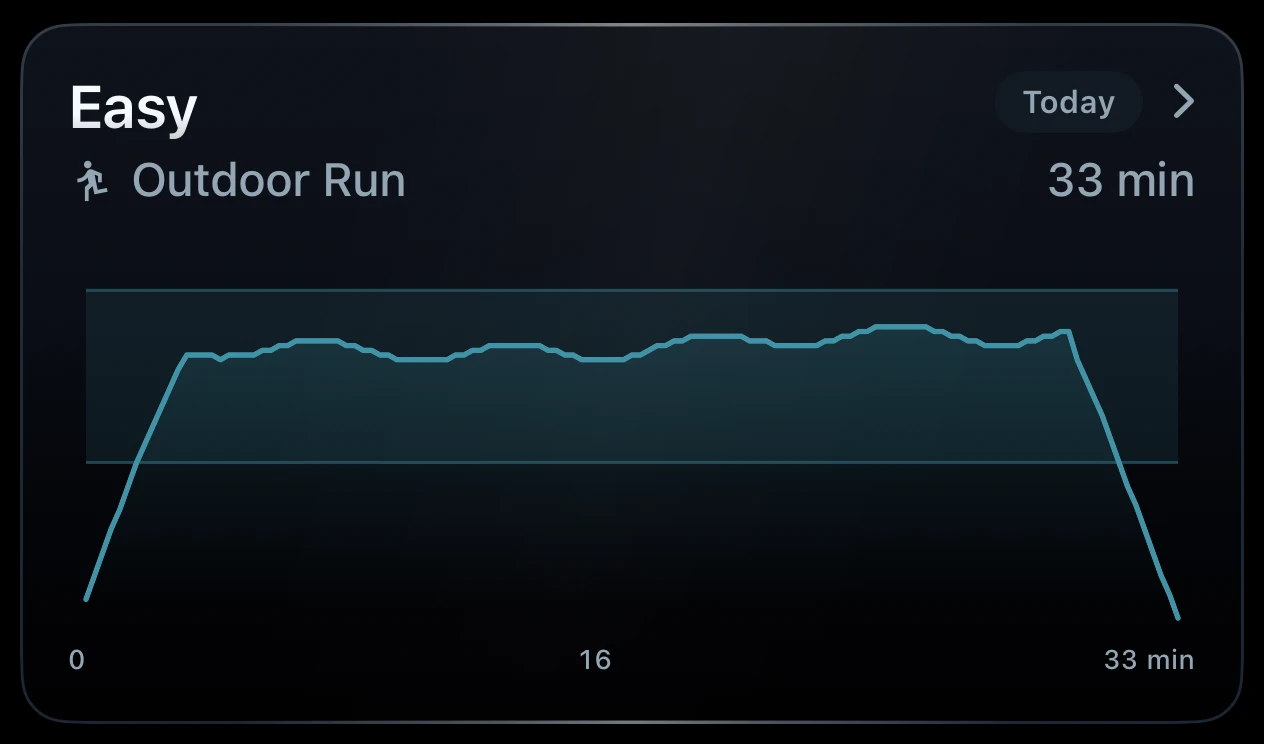
The bands below show the heart rate for each kind of work. The Zone 2 you know is the Easy band, and Easy builds your aerobic base. Threshold is the fastest pace you can hold before fatigue stacks up quickly. The top band shares its name with VO₂max, and it is the band for hard intervals. Type your age to see your own bands.
Find your heart rate zones
Type your age. Add your sex and a max you have seen if you know them. The example below is a 35-year-old.
Age 35 · max heart rate 208 − 0.7 × 35 = 184, an estimate
Your Easy band, your Zone 2111 to 146beats a minute
Your Easy band runs 16 beats higher than the common Zone 2 chart lets you go.
Max from age uses Tanaka’s formula (208 − 0.7 × age). Easy ends where blood tests find lactate starting to rise, which is higher for women than for men. What you type stays on this page.
Diastra reads your max from your own Apple Watch workouts or a guided test and draws your bands from it.
Start my free trialA classic interval session for VO₂max is the Norwegian 4x4 workout. A 2007 study compared it with three other kinds of training in 40 moderately trained men. Each group trained three days a week for 8 weeks[8]. The group that ran four 4-minute intervals at 90 to 95% of max heart rate raised VO₂max 7.2%. Groups that did the same total work at 70% or 85% of max gained less[8].
The guide on how to improve VO₂max shows how a full week puts Easy and the hard sessions together.
How long does it take for Cardio Fitness to change?
Lab studies measure changes in VO₂max over weeks of training. The 4x4 study saw its 7.2% gain after 8 weeks[8]. A 12-week study had 39 adults who had not been exercising train three days a week. Their average VO₂max rose from 24.3 to 26.0 in one group and from 29.2 to 32.8 in the other[9].
That team set a bar for a real change. The test's own error in that group was 4.7%. The team called a person improved only when VO₂max rose by more than that[9]. A small move can be noise even in a lab.
The 4x4 gain of 7.2% is larger than the 3.4% typical spread Apple found across one person's estimates[2]. No outside study has yet checked whether the watch's estimate follows a real change like that one[5].
Fitness also fades when training stops. A 1984 study followed 7 endurance-trained people who stopped training for 84 days[10]. Their VO₂max fell 7% in the first 21 days. It settled 16% below where it started by day 56. After 84 days it was still higher than in 8 people who had never trained[10].
None of these studies tested the watch. They measured VO₂max in a lab. Use the six month view for the trend, and compare readings from the same kind of outdoor workout.
Diastra does not use the Cardio Fitness number. It reads every workout your Apple Watch saved in Apple Health. It finds your max heart rate in those workouts and draws Easy, Threshold and VO₂max from it. On the watch it holds you in your band with a tap when you drift out. Over the weeks it reads your heart rate in those workouts and shows whether your training is working. Getting fitter. Holding steady. Slipping.
See your own bands from your own workouts.
Diastra reads every workout your Apple Watch saved, finds your real max heart rate and draws Easy, Threshold and VO₂max from it. Then it holds you in your band on every run and shows you over the weeks whether your training is working.
Start my free trial$119 a year, or $19.99 a month. Seven days free. For iPhone and Apple Watch.
More questions
What is the highest Cardio Fitness Apple Watch can show?
Apple says the watch supports a range of 14 to 65 mL/kg/min. A lab result above 65 is past what the watch can show.
Can Cardio Fitness go down when you train more?
A single estimate can dip for reasons that have nothing to do with your fitness. Apple names heat, caffeine, a recent move to high altitude, carrying a heavy load and running on sand among them. Compare months, and read one low day as one reading.
How close is Cardio Fitness to a lab VO₂max test?
Cardio Fitness is Apple's estimate of VO₂max, in the same mL/kg/min units a lab uses. Three lab studies of mostly young and fit adults found that the watch read 4.5 to 6.3 mL/kg/min lower than the lab on average.
Does skin tone change the heart rate reading?
A 2020 study of wrist heart rate sensors found no clear difference in accuracy across skin tones. Apple says some tattoos can block the sensor's light and make a reading harder to get. Cold weather can do the same by lowering blood flow in the skin of your wrist.
Sources
- Apple Support. Track your cardio fitness levels. Published September 14, 2026. Read October 4, 2026.The workouts that give an estimate, the rule that leaves indoor workouts out, the Health app steps, the 24 hours of wear, the age of 20 for levels and the 14 to 65 range.
- Apple. May 2021. Using Apple Watch to Estimate Cardio Fitness with VO2 max. Apple white paper. Read October 4, 2026.How the estimate works, the flat ground and heart rate rules, what helps and what throws an estimate off, and how often outdoor workouts gave an estimate.
- Apple Newsroom. December 14, 2020. Cardio fitness notifications are available today on Apple Watch. Read October 4, 2026.Apple sorts each estimate into four levels (high, above average, below average and low) against people of the same age group and sex using FRIEND data, and since watchOS 7 the watch can take readings during everyday walks.
- Apple Support. Get the most accurate measurements using your Apple Watch. Published March 10, 2026. Read October 4, 2026.A snug fit for workouts, Indoor Run for a treadmill, and the things that can disturb the heart rate sensor.
- Lambe R, Schumann M, Donnelly L, Hamilton S, Lally S, Rafter E, O'Reilly S, White T, Doherty C. 2026. Accuracy of VO2 max Estimates From Apple Watch Series 10. Mayo Clin Proc Digit Health 4(2):100357.40 adults started and 35 were analyzed. The Series 10 read 6.3 points low on average and matched the lab percentile band for 5 people, and 4 people got no estimate within a week.
- Lambe R, O'Grady B, Baldwin M, Doherty C. 2025. Investigating the accuracy of Apple Watch VO2 max measurements: A validation study. PLoS One 20(5):e0323741.28 adults wore Apple Watches from Series 5 to Series 9, SE 2 and Ultra 2. The watch read 6.1 points below a treadmill lab test on average.
- Caserman P, Yum S, Göbel S, Reif A, Matura S. 2024. Assessing the Accuracy of Smartwatch-Based Estimation of Maximum Oxygen Uptake Using the Apple Watch Series 7: Validation Study. JMIR Biomed Eng 9:e59459.19 adults did a lab test on a bike. The Series 7 averaged 41.4 against 45.9 in the lab.
- Helgerud J, Høydal K, Wang E, Karlsen T, Berg P, Bjerkaas M, Simonsen T, Helgesen C, Hjorth N, Bach R, Hoff J. 2007. Aerobic high-intensity intervals improve VO2max more than moderate training. Med Sci Sports Exerc 39(4):665-671.40 moderately trained men trained three days a week for 8 weeks. Four 4-minute intervals at 90 to 95% of max raised VO₂max 7.2%, more than the same work at 70% or 85% of max.
- Weatherwax RM, Harris NK, Kilding AE, Dalleck LC. 2019. Incidence of VO2max Responders to Personalized versus Standardized Exercise Prescription. Med Sci Sports Exerc 51(4):681-691.39 adults who had not been exercising trained three days a week for 12 weeks. Average VO₂max rose from 24.3 to 26.0 in one group and from 29.2 to 32.8 in the other.
- Coyle EF, Martin WH 3rd, Sinacore DR, Joyner MJ, Hagberg JM, Holloszy JO. 1984. Time course of loss of adaptations after stopping prolonged intense endurance training. J Appl Physiol 57(6):1857-1864.7 endurance-trained people stopped training. VO₂max fell 7% in 21 days and settled 16% lower by day 56, still above people who had never trained.
- Bent B, Goldstein BA, Kibbe WA, Dunn JP. 2020. Investigating sources of inaccuracy in wearable optical heart rate sensors. NPJ Digit Med 3:18.Wrist heart rate error was 30% higher during activity than at rest, with no clear difference in accuracy across skin tones.
- Gillinov S, Etiwy M, Wang R, Blackburn G, Phelan D, Gillinov AM, Houghtaling P, Javadikasgari H, Desai MY. 2017. Variable accuracy of wearable heart rate monitors during aerobic exercise. Med Sci Sports Exerc 49(8):1697-1703.In 50 adults, Apple Watch heart rate agreed with the lab reference at 0.92 with all the exercise in the study pooled together.