 Diastra
 Is my training working · Part 1 of 3
Why is my VO₂max not improving?
A flat VO₂max can mean the training block is still young, the week holds too few easy minutes, or the watch estimate is moving more than your fitness. In one training study, every person who showed no gain at a low dose improved once they trained more often.
On this page
How long does VO₂max take to go up?
VO₂max is your aerobic capacity. It is the most oxygen your body can use when you go all-out. It is measured in milliliters of oxygen for each kilogram of body weight each minute. You will see it written as mL/kg/min, and this page calls one of those units a point.
Training raises VO₂max over weeks. A 2019 study trained 39 adults who had not been exercising three days a week for 12 weeks[2]. Each person took a lab test every 4 weeks[1]. In one group the average went from 24.3 points to 24.7 at week 4. It reached 25.9 at week 8 and 26.0 at week 12[1].
The rise at week 4 was too small for the study to be sure of. The rise was clear by week 8[1]. A smaller study of 8 younger and 8 older men saw VO₂max rise within 3 weeks of cycling three times a week[3]. Both groups kept gaining up to week 12.
Group averages can move early. One person's number is harder to read, because every measure of VO₂max moves a little from one test to the next. Give a block of steady training about 8 weeks before you judge it.
Do some people gain less than others?
They do, and the gap between people can be wide. The HERITAGE Family Study put 481 adults who had not been exercising through the same 20-week program[4]. The training was on exercise bikes[5]. VO₂max rose by about 0.4 liters of oxygen a minute on average. Some people gained little or nothing. Others gained more than 1 liter a minute[4].
Families tended to respond alike. The team estimated that genes explained up to 47% of the differences in gains[4]. A later look at 633 people in the same study found big, medium and small gains in every age group and in both sexes. It found them at every starting fitness level too. Age, sex and starting fitness had little effect on the size of the gain[5].
Researchers used to call the people with no gain "non-responders." That label is now in question. A 2017 review pointed out that a lab VO₂max test moves from one visit to the next even with no training[6]. The review found one older study that also tested a group who did not train. In that study, changes in the training group spread out less than changes in the group who did not train[6].
So a flat number can mean the training dose was too small to move you yet. It can also mean the measurement hid a gain.
Does more training get a stalled VO₂max moving?
In one study it did, for every person. A 2017 study gave 78 healthy adults one to five 60-minute sessions a week for 6 weeks[7]. The study judged each gain by the top workload a person reached in a hard test, and that number moved with VO₂max. People who did fewer sessions were more likely to show no gain. Everyone who had shown no gain then trained 6 more weeks with two extra sessions a week. Every one of them improved[7]. The guide on how to improve VO₂max gives that study's numbers for each group.
The study also looked at why. It tied the gains in VO₂max mostly to a rise in hemoglobin mass[7]. Hemoglobin is the part of your blood that carries oxygen to your muscles.
A different kind of training can help too. A 2016 study had 21 recreationally active adults try two programs[8]. One was 3 weeks of steady 30-minute rides. The other was 3 weeks of sessions built from eight 20-second sprints. Each person did both programs, with 3 months between them.
Some people showed no VO₂max gain after one of the programs. A person's gain on one program did not predict their gain on the other[8]. The study tracked three measures. They were VO₂max, the workload where lactate starts to build in the blood and the heart rate at a set workload. Every person improved in at least one of the three across the two programs[8].
Is most of your week easy?
The fastest marathon runners train much more, and most of the extra time is easy. A 2025 study looked at the 16 weeks of training before 151,813 marathons[9]. The fastest runners in the data ran more than three times the weekly volume of slower runners. Their time at harder efforts stayed about the same across every level. The extra volume came mostly from easy running[9].
This study shows what faster runners did. It cannot prove that the easy volume made them faster. It does show that harder running did not grow with ability in these runners. So when VO₂max stalls, your easy minutes are the first place to look.
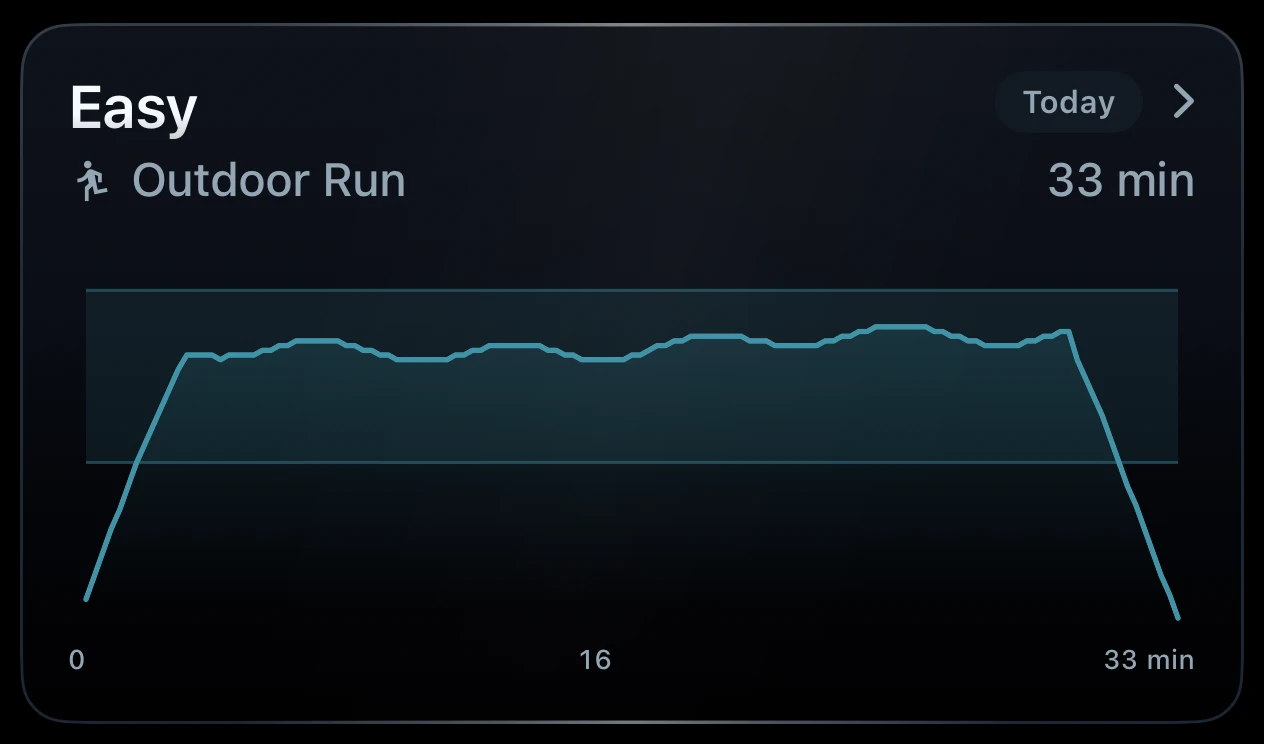
Easy is the pace you can hold a conversation at, and it builds your aerobic base. The Zone 2 you know is Diastra's Easy band. It runs from 60% of your max heart rate up to 79% for men and 83% for women. Blood tests on 165 recreational runners found that lactate starts to rise close to those points on average[10]. Type your age to see your own bands.
Find your heart rate zones
Type your age. Add your sex and a max you have seen if you know them. The example below is a 35-year-old.
Age 35 · max heart rate 208 − 0.7 × 35 = 184, an estimate
Your Easy band, your Zone 2111 to 146beats a minute
Your Easy band runs 16 beats higher than the common Zone 2 chart lets you go.
Max from age uses Tanaka’s formula (208 − 0.7 × age). Easy ends where blood tests find lactate starting to rise, which is higher for women than for men. What you type stays on this page.
Diastra reads your max from your own Apple Watch workouts or a guided test and draws your bands from it.
Start my free trialEvery band on that card is a share of your max heart rate. A max guessed from age can miss one runner by a wide margin, and finding your max heart rate with Apple Watch shows how to use the max your own runs have shown.
Do gray-band minutes slow your progress?
Between Easy and Threshold is the gray band. A common idea says middle-effort running holds your fitness back.
The studies find something milder. A 2007 study gave 12 sub-elite runners two training plans for 5 months[11]. One plan put about 80% of the training at an easy effort and 12% in the middle. The other put about 67% at an easy effort and 25% in the middle. Both plans had about 8% hard work[11].
Both groups got faster in a 10.4-kilometer race. The mostly easy group cut 157 seconds. The group with more middle effort cut 121.5 seconds[11]. The runners with more middle effort still got faster. The weeks that kept more of those minutes easy improved more.
A 2024 review pooled 17 studies that compared polarized plans with other ways to split the week[12]. A polarized plan is mostly easy with some hard work and little in the middle. The polarized plans gave a small extra VO₂max gain. That edge showed up in programs shorter than 12 weeks and in highly trained athletes. Time trial results came out the same[12].
Gray minutes still train you. In a stalled week some of them can slow down into Easy, and the week gains easy minutes with no extra time. Polarized training compares the ways to split a full week.
Can the watch hide a real gain?
It can. Apple Watch estimates VO₂max as Cardio Fitness from Outdoor Walk, Outdoor Run and Hiking workouts. Indoor workouts are left out, and that includes workouts on gym equipment[13]. A runner who trains mostly indoors may see a number that stays the same because the watch has had little new to read.
The estimate also moves on its own. Apple followed 221 people for about 390 days on average[14]. A typical person's estimates spread by 1.2 points around their own average. One person in ten saw a spread of 2.6 points or more[14].
Real gains can be about that size. The group in the 12-week study above went from 24.3 to 26.0, a gain of 1.7 points on average[1]. On a watch, a gain like that can hide inside the ordinary spread of the readings.
The watch's level adds a second layer. In a 2026 study of the Series 10, the watch read 6.3 points below a lab test on average[15]. In an exploratory check, the fittest group read 7.8 points low and the less fit group read 2.4 points low. If that pattern held for one runner over time, a real gain could look smaller on the watch. No outside team has yet tested how the estimate follows a change over time[15]. The guide to Apple Watch VO₂max accuracy covers each of the lab studies.
Read the number across months. Compare readings from the same kind of outdoor run on similar ground and in similar weather. One reading is a data point, and a direction takes several readings that agree. When the number drops instead of stalling, why your Apple Watch VO₂max dropped goes through the causes.
What should you check first?
Look at the last few months of training before you change anything.
- The calendar. A block younger than about 8 weeks may not show a gain yet[1].
- The sessions. More sessions a week turned no gain into a gain in the 2017 dose study[7].
- The easy minutes. The fastest marathon runners did much more easy running and about the same hard running as slower runners[9].
- The gray band. Some middle-effort minutes can slow down into Easy.
- The kind of training. A person's gain on one program did not predict their gain on another[8].
- The watch. Read Cardio Fitness over months, from comparable outdoor runs.
Where does Diastra fit?
Diastra reads every workout your Apple Watch saved in Apple Health. It finds your max heart rate in those workouts and draws Easy, Threshold and VO₂max from it. It credits only the minutes your heart held in a band, and it builds a weekly plan that rebuilds around the runs you did. Over the weeks Diastra shows whether your training is working. Getting fitter. Holding steady. Slipping.
See your own bands from your own workouts.
Diastra reads every workout your Apple Watch saved, finds your real max heart rate and draws Easy, Threshold and VO₂max from it. Then it holds you in your band on every run and shows you over the weeks whether your training is working.
Start my free trial$119 a year, or $19.99 a month. Seven days free. For iPhone and Apple Watch.
More questions
Can you get fitter while VO₂max stays the same?
You can. A 2016 study tracked VO₂max, lactate threshold and heart rate at a set workload[8]. Every person improved at least one of the three across two training programs. A 2024 review found that polarized plans gave a small VO₂max edge while time trial results came out the same[12]. VO₂max and race results can move on their own schedules.
Do women and older runners gain less?
In the HERITAGE study, men and women gained about the same number of points. Women started lower, so their gain was larger as a percent[5]. Older people gained fewer points than younger people and about the same percent. Big, medium and small gains showed up in every group[5].
Is VO₂max set by your genes?
Genes play a part. The HERITAGE team estimated that genes explained up to 47% of the differences in how much people gained[4]. VO₂max still rose on average in every group the study looked at[5]. In the 2017 dose study, every person who had shown no gain improved once they trained more often[7].
Should you get a lab test to check a plateau?
A lab test measures your oxygen use directly with a mask. It still moves from one visit to the next. One 12-week study found the test's own error was 4.7% and called a person improved only when VO₂max rose by more than that[2]. Repeat any test with the same method a few months apart. The Cooper test is a fitness benchmark you can repeat on your own.
Sources
- Weatherwax R, Harris N, Kilding AE, Dalleck L. 2019. Time Course Changes in Confirmed 'True' VO2max After Individualized and Standardized Training. Sports Med Int Open 3(2):E32-E39.39 adults were tested every 4 weeks. In one group VO₂max went from 24.3 to 24.7, 25.9 and 26.0, with a clear rise at weeks 8 and 12.
- Weatherwax RM, Harris NK, Kilding AE, Dalleck LC. 2019. Incidence of VO2max Responders to Personalized versus Standardized Exercise Prescription. Med Sci Sports Exerc 51(4):681-691.39 adults who had not been exercising trained three days a week for 12 weeks. The team called a person improved only above the test's own error of 4.7%.
- Murias JM, Kowalchuk JM, Paterson DH. 2010. Time course and mechanisms of adaptations in cardiorespiratory fitness with endurance training in older and young men. J Appl Physiol 108(3):621-627.8 older and 8 young men cycled 45 minutes three times a week. VO₂max rose within 3 weeks and kept rising to week 12.
- Bouchard C, An P, Rice T, Skinner JS, Wilmore JH, Gagnon J, Pérusse L, Leon AS, Rao DC. 1999. Familial aggregation of VO2max response to exercise training. Results from the HERITAGE Family Study. J Appl Physiol 87(3):1003-1008.481 adults from 98 families trained for 20 weeks. VO₂max rose about 0.4 liters a minute on average, from little or nothing to more than 1 liter, and genes explained up to 47% of the differences.
- Skinner JS, Jaskólski A, Jaskólska A, Krasnoff J, Gagnon J, Leon AS, Rao DC, Wilmore JH, Bouchard C. 2001. Age, sex, race, initial fitness, and response to training. The HERITAGE Family Study. J Appl Physiol 90(5):1770-1776.633 adults aged 17 to 65 trained on exercise bikes. VO₂max rose in every group, and big, medium and small gains showed up at every age, in both sexes and at every starting fitness level.
- Williamson PJ, Atkinson G, Batterham AM. 2017. Inter-Individual Responses of Maximal Oxygen Uptake to Exercise Training. A Critical Review. Sports Med 47(8):1501-1513.Most studies of who gains and who does not had no group that skipped training. In the one older study that did, the spread of changes was larger in the group that did not train.
- Montero D, Lundby C. 2017. Refuting the myth of non-response to exercise training. 'Non-responders' do respond to higher dose of training. J Physiol 595(11):3377-3387.78 healthy adults trained one to five 60-minute sessions a week for 6 weeks. Everyone who showed no gain in top workload improved after 6 more weeks with two extra sessions a week, and VO₂max gains tracked hemoglobin mass.
- Bonafiglia JT, Rotundo MP, Whittall JP, Scribbans TD, Graham RB, Gurd BJ. 2016. Inter-Individual Variability in the Adaptive Responses to Endurance and Sprint Interval Training. A Randomized Crossover Study. PLoS One 11(12):e0167790.21 adults did 3 weeks of steady cycling and 3 weeks of sprint intervals. A gain on one program did not predict a gain on the other, and everyone improved in at least one measure.
- Muniz-Pumares D, Hunter B, Meyler S, Maunder E, Smyth B. 2025. The Training Intensity Distribution of Marathon Runners Across Performance Levels. Sports Med 55(4):1023-1035.Training before 151,813 marathons. The fastest runners ran more than three times the volume of slower runners, mostly as extra easy running, while time at harder efforts stayed about the same.
- Nuuttila OP, Kaikkonen P, Sievänen H, Vasankari T, Kyröläinen H. 2025. The accuracy of fixed intensity anchors to estimate lactate thresholds in recreational runners. Eur J Appl Physiol 125(8):2161-2171.Blood tests on 165 recreational runners found lactate starts to rise at 78.9% of max for men and 83.6% for women on average.
- Esteve-Lanao J, Foster C, Seiler S, Lucia A. 2007. Impact of training intensity distribution on performance in endurance athletes. J Strength Cond Res 21(3):943-949.12 sub-elite runners trained for 5 months. Both groups got faster over 10.4 km, by 157 seconds with about 80% easy and by 121.5 seconds with about 67% easy.
- Silva Oliveira P, Boppre G, Fonseca H. 2024. Comparison of Polarized Versus Other Types of Endurance Training Intensity Distribution on Athletes' Endurance Performance. A Systematic Review with Meta-analysis. Sports Med 54(8):2071-2095.17 studies with 437 people. Polarized plans gave a small extra VO₂max gain in programs under 12 weeks and in highly trained athletes, and time trials came out the same.
- Apple Support. Track your cardio fitness levels. Published September 14, 2026. Read October 6, 2026.The estimate comes from Outdoor Walk, Outdoor Run and Hiking workouts, and indoor workouts are left out.
- Apple. May 2021. Using Apple Watch to Estimate Cardio Fitness with VO2 max. Apple white paper. Read October 6, 2026.In 221 people followed for about 390 days, a typical person's estimates spread by 1.2 points, and one person in ten saw a spread of 2.6 or more.
- Lambe R, Schumann M, Donnelly L, Hamilton S, Lally S, Rafter E, O'Reilly S, White T, Doherty C. 2026. Accuracy of VO2 max Estimates From Apple Watch Series 10. Mayo Clin Proc Digit Health 4(2):100357.35 adults with a Series 10. The watch read 6.3 points below a lab test on average, 7.8 low in the fittest group and 2.4 low in the less fit group, and no outside team had yet tested it over time.