 Diastra
 Max heart rate · Part 3 of 4
Max heart rate formulas compared, from 220 minus age to Tanaka
220 minus your age is the best-known max heart rate formula, and Tanaka's formula of 208 minus 0.7 times your age comes from 351 studies with 18,712 people. The common formulas miss a typical person by about 7 to 12 beats a minute, so a max you measure in your own hard efforts is the better number.
On this page
- Where did 220 minus age come from?
- Which max heart rate formulas have real studies behind them?
- Where does each formula read high or low?
- How do the formulas hold up on new people?
- Is there a max heart rate formula for women?
- Does fitness change your max heart rate?
- Why does the right max matter for your zones?
- Which formula should you use?
- How does Diastra use Tanaka's formula?
- More questions
- Sources
Where did 220 minus age come from?
The formula first appeared in a 1971 paper by Fox and two colleagues[1]. They gathered about 35 data points from about 11 sources, and some of those sources were never published. Then they drew a line through the points by eye. They did no math to fit the line[1].
Fox and his colleagues wrote under their chart that "no single line will adequately represent the data"[1]. The line was a rough guide.
In 2002 the exercise scientists Robert Robergs and Roberto Landwehr traced the formula back to that paper[1]. They found it did not come from original research.
Textbooks often tie the formula to the scientist Karvonen, so Robergs and Landwehr asked him too. Karvonen told them he never published original research on it[1]. His own work was on heart rate reserve. That method also uses your resting heart rate.
Their review found a bigger problem. More than two decades of research showed the estimate missing a real person's max by a typical 7 to 11 beats a minute[1]. Most other formulas built on age alone missed by more than 10 beats[1]. Every formula on this page has a spread like this, and that includes the good ones.
Which max heart rate formulas have real studies behind them?
Four research teams built a formula from measured max heart rates. The table puts them next to 220 minus age. Each row shows the max heart rate in beats a minute that the formula gives at ages 30, 45 and 60.
| Formula | Study | Who it came from | Age 30 | Age 45 | Age 60 |
|---|---|---|---|---|---|
| 220 − age | Fox, 1971 | About 35 data points from about 11 sources, line drawn by eye | 190 | 175 | 160 |
| 208 − 0.7 × age | Tanaka, 2001 | 18,712 people in 351 studies, then 514 adults tested in a lab | 187 | 176.5 | 166 |
| 207 − 0.7 × age | Gellish, 2007 | 132 adults tested 908 times over 25 years | 186 | 175.5 | 165 |
| 211 − 0.64 × age | Nes, 2013 (HUNT) | 3,320 healthy Norwegian adults aged 19 to 89 | 191.8 | 182.2 | 172.6 |
| 206 − 0.88 × age | Gulati, 2010 | 5,437 women with an average age of 52 | 179.6 | 166.4 | 153.2 |
Each number comes straight from that study's own formula[2][3][4][7][5]. Gulati's women had an average age of 52, so the formula's age-30 number is a long way from most of the women it measured. At age 45 the five rows run from 166.4 to 182.2. That is a gap of almost 16 beats between formulas for the same person.
Where does each formula read high or low?
220 minus age
220 minus age and Tanaka's formula both give 180 at age 40. 220 minus age gives the higher number below 40. Above 40 it gives the lower one, and the gap grows by 0.3 beats a minute with every year.
The gap is 6 beats at 60 and 9 beats at 70. Tanaka's team found that 220 minus age reads too low for older adults[2].
Tanaka
Tanaka's team first pooled 351 earlier studies with 18,712 people[2]. Then they measured max heart rate in 514 healthy adults in their own lab to check the line. The line came out the same for men and women[2].
Gellish
Tanaka's line came from comparing people of different ages at one point in time. Gellish's team took the other route. Their 132 adults took 908 max tests over 25 years, and each person was tested more than once[3]. That let the team track each person's max as they aged.
Their line came out one beat below Tanaka's at every age. Two different ways of studying max heart rate landed on the same slope of 0.7 beats for each year of age.
Nes and the HUNT study
The HUNT Fitness Study measured max heart rate in 3,320 healthy Norwegians aged 19 to 89[4][7]. The older formulas read too low for its people over 30 and for its women[4].
The HUNT line falls more slowly with age. That keeps it the highest of the five at every age in the table. Its typical miss for a single person was 10.8 beats a minute[4].
How do the formulas hold up on new people?
A fair check tests a formula on people outside its own study. In 2020 Shookster and colleagues did this with 99 adults who reached a true max on a treadmill[6]. Sixty-seven were men and 32 were women. The group was fitter than average, and its measured max averaged 181.7 beats a minute.
Tanaka's formula, Gellish's formula and 220 minus age each landed within half a beat of that group average[6]. The HUNT formula came out about 5 beats high for the group. Gulati's formula came out about 8 beats low for the 32 women[6].
The misses for single people were large. The typical miss was about 11 to 12 beats for 220 minus age, Tanaka, Gellish and HUNT[6]. Gulati's formula missed a typical woman by about 15 beats[6]. The statistics put about 19 in 20 people within about 21 beats of Tanaka's number and within about 23 beats of 220 minus age[6].
The authors concluded that every formula agreed poorly with the max people reached[6]. The formulas got the group right and missed many single people by a wide margin.
Is there a max heart rate formula for women?
Gulati's team built one from 5,437 women with an average age of 52. It comes from the highest heart rate each woman reached in an exercise test. Their formula is 206 minus 0.88 times your age[5].
At 50 the women's formula gives 162. That is 8 beats below 220 minus age.
Two other large studies found no need for a separate line. Tanaka's team found the same line for men and women[2]. The HUNT study found only small differences between men and women of the same age[4].
The HUNT women reached higher maxes than the older formulas expected[4]. Gulati's formula read about 8 beats low for the women in Shookster's check[6].
So a woman gets a low estimate from Gulati's formula and a high one from the HUNT formula. At 45 those two are 15.8 beats apart. Her own measured max settles the question.
Does fitness change your max heart rate?
Training does not raise your max heart rate[7]. Tanaka's team found the same line for people who trained a lot and people who did not[2]. The HUNT team at NTNU writes that genes shape max heart rate more than fitness does[7].
The HUNT study found only small differences between people of the same age by activity level, body size or VO₂max[4]. VO₂max is the most oxygen your body can use.
A high max is no sign of a fit runner. A low max is no sign of an unfit one either. Two runners of the same age and the same fitness can have max heart rates far apart[4].
Why does the right max matter for your zones?
Most heart rate zones are a share of your max. A wrong max moves every zone edge with it.
Take a 45-year-old runner. Tanaka's formula gives 176.5. A line at 80% of max puts the top of easy running at 141 beats a minute.
Say this runner's real max is 10 beats higher than the formula. A real max of 186.5 moves the top of easy running up to 149. The formula would end this runner's easy running 8 beats too early.
The miss can go the other way too. A real max 10 beats lower puts the top of easy running 8 beats too high. A measured max moves every band to its right place at once.
Which formula should you use?
Start with Tanaka's formula when you have no measured max. It comes from the most data[2]. A study that tracked the same people over 25 years landed within one beat of it[3]. Robergs and Landwehr pooled 30 formulas from healthy people into one line, and that line came out very close to Tanaka's too[1].
220 minus age matched the group average just as well as Tanaka's formula in the 2020 check[6]. The two give the same number at age 40. Tanaka's formula gives the higher number above 40.
The choice of formula matters less than it seems. Tanaka, Gellish and 220 minus age stay within 6 beats of each other from age 30 to 60. Real people are a typical 7 to 12 beats away from all three[1][6]. A max you measured in a real all-out effort is closer to the truth than any formula.
Type your age and sex below to see your bands from Tanaka's estimate. Add your max from a race or a test and watch the bands move.
Find your heart rate zones
Type your age. Add your sex and a max you have seen if you know them. The example below is a 35-year-old.
Age 35 · max heart rate 208 − 0.7 × 35 = 184, an estimate
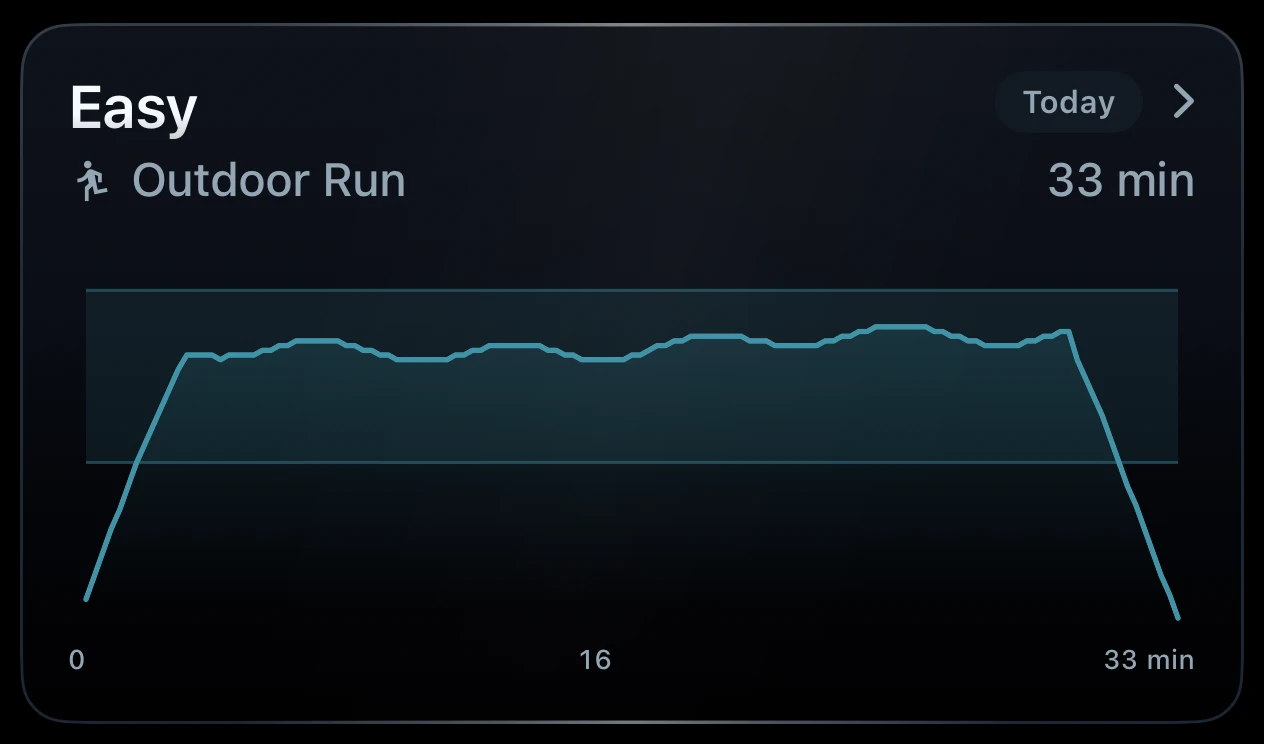
Your Easy band, your Zone 2111 to 146beats a minute
Your Easy band runs 16 beats higher than the common Zone 2 chart lets you go.
Max from age uses Tanaka’s formula (208 − 0.7 × age). Easy ends where blood tests find lactate starting to rise, which is higher for women than for men. What you type stays on this page.
Diastra reads your max from your own Apple Watch workouts or a guided test and draws your bands from it.
Start my free trialA max from your own workouts replaces every formula on this page. How to find your max heart rate on Apple Watch shows where to look and what a believable peak looks like. Max heart rate by age shows the estimate at every age from 18 to 75. The max heart rate calculator works out yours in one step.
How does Diastra use Tanaka's formula?
Diastra starts from Tanaka's formula when it has no measured max for you. It reads every workout your Apple Watch saved in Apple Health and looks for the highest heart rate you held in a hard effort. A workout peak above the estimate becomes your max once a second hard session reaches within 8 beats of it.
A guided test that tops both the estimate and your current max becomes your max at once. A number you type sets your max too. Your max carries a label that says Estimate, Observed, Entered or Verified, so you can see where the number came from.
The Zone 2 you know is Diastra's Easy band. Easy, Threshold and VO₂max are all drawn from your max. Easy's top edge is split by sex, because blood tests on 165 runners found lactate starts to rise at a higher share of max in women than in men[8]. Every study behind the bands is on how Diastra draws your bands.
See your own bands from your own workouts.
Diastra reads every workout your Apple Watch saved, finds your real max heart rate and draws Easy, Threshold and VO₂max from it. Then it holds you in your band on every run and shows you over the weeks whether your training is working.
Start my free trial$119 a year, or $19.99 a month. Seven days free. For iPhone and Apple Watch.
More questions
Why do different apps show different max heart rates?
Each app picks its own formula, and some also read your workouts. At age 45 the five formulas on this page give anything from 166.4 to 182.2 beats a minute. A max you measured in your own hard efforts stays the same from app to app.
What does the 0.7 in Tanaka's formula mean?
It is how fast the estimate drops with age. Each year of age takes 0.7 beats a minute off the estimate, so it falls 7 beats over 10 years. 220 minus age takes a full beat off each year, and that is why the two formulas give different numbers on both sides of age 40.
Does the Karvonen method get around the formula problem?
The Karvonen method takes your resting heart rate away from your max and works out its zones from that gap. The gap is called heart rate reserve. The method still starts from a max heart rate, so a max that is off by 10 beats moves every Karvonen zone too.
Why does the HUNT formula give higher numbers than the others?
The HUNT line drops only 0.64 beats a minute for each year of age. The other formulas drop faster, so the HUNT line is the highest of them from about age 25 up. A separate check on 99 adults who reached a true max found the HUNT formula about 5 beats high on average.
Sources
- Robergs RA, Landwehr R. 2002. The surprising history of the "HRmax=220-age" equation. Journal of Exercise Physiology Online 5(2):1-10.Traced 220 minus age to a 1971 line drawn by eye through about 35 data points from about 11 sources, and found the estimate misses people by a typical 7 to 11 beats a minute.
- Tanaka H, Monahan KD, Seals DR. 2001. Age-predicted maximal heart rate revisited. J Am Coll Cardiol 37(1):153-156.Pooled 351 studies with 18,712 people, checked the result on 514 adults in a lab, and found 208 minus 0.7 times age, with the same line for men and women and for active and inactive people.
- Gellish RL, Goslin BR, Olson RE, McDonald A, Russi GD, Moudgil VK. 2007. Longitudinal modeling of the relationship between age and maximal heart rate. Med Sci Sports Exerc 39(5):822-829.Tracked 132 adults through 908 max tests over 25 years and found 207 minus 0.7 times age.
- Nes BM, Janszky I, Wisløff U, Støylen A, Karlsen T. 2013. Age-predicted maximal heart rate in healthy subjects: The HUNT fitness study. Scand J Med Sci Sports 23(6):697-704.Measured 3,320 healthy Norwegian adults and found 211 minus 0.64 times age, with a typical miss of 10.8 beats a minute and only small differences by sex, activity, VO₂max or body size.
- Gulati M, Shaw LJ, Thisted RA, Black HR, Bairey Merz CN, Arnsdorf MF. 2010. Heart rate response to exercise stress testing in asymptomatic women: the St. James Women Take Heart Project. Circulation 122(2):130-137.Built a women's formula of 206 minus 0.88 times age from the peak heart rates of 5,437 women with an average age of 52.
- Shookster D, Lindsey B, Cortes N, Martin JR. 2020. Accuracy of commonly used age-predicted maximal heart rate equations. Int J Exerc Sci 13(7):1242-1250.Checked the formulas on 99 adults who reached a true max. Several formulas matched the group average, but the typical miss for one person was about 11 to 15 beats a minute.
- NTNU Cardiac Exercise Research Group. Maximum heart rate (HRmax) calculator. Norwegian University of Science and Technology.The HUNT research group's own page. It gives the formula from 3,320 adults aged 19 to 89, says genes shape max heart rate more than fitness does, and says exercise does not change it.
- Nuuttila OP, Kaikkonen P, Sievänen H, Vasankari T, Kyröläinen H. 2025. The accuracy of fixed intensity anchors to estimate lactate thresholds in recreational runners. Eur J Appl Physiol 125(8):2161-2171.Blood tests on 165 recreational runners found lactate starts to rise at 78.9% of max for men and 83.6% for women.