 Diastra
 VO₂max · Part 3 of 6
How accurate is the Apple Watch VO₂max estimate?
Three lab studies run outside Apple compared Apple Watch with a lab test in 82 mostly young and fit adults, and the watch read VO₂max 4.5 to 6.3 mL/kg/min lower on average. Apple's own data show that one person's estimates stay close together, so the number is more useful for following your own trend over months.
On this page
How does Apple Watch estimate VO₂max?
VO₂max is your aerobic capacity. It is the most oxygen your body can use when you go all-out. A lab measures it with an exercise test on a treadmill or a bike[1]. You wear a mask that measures the air you breathe while the work gets harder and harder.
Apple Watch estimates the same number with no mask. Apple calls the estimate Cardio Fitness. Apple's 2021 paper says the watch measures how your heart rate responds to the work of walking, running or hiking outdoors[1]. The watch needs a good GPS signal and a good heart rate signal. The ground needs to be fairly flat. Apple sets the limit at a slope under 5% up or down[1].
Your heart rate also has to climb far enough. Apple's paper puts that bar at about 30% of the way from your resting heart rate to your max[1]. Here is Apple's rule with real numbers. Say you rest at 60 beats a minute and your max is 190. The gap is 130 beats, and 30% of that is 39. So the walk or run has to lift your heart rate to about 99 or higher.
The watch also uses details you entered in the Health app. Apple lists age, sex, weight and height among them[2]. The page on Cardio Fitness on Apple Watch shows where to find the number and what Apple's levels mean.
VO₂max is measured in milliliters of oxygen for each kilogram of body weight each minute. You will see it written as mL/kg/min. This page calls one of those units a point.
What did Apple's own study find?
Apple built its method from 534 people. Then Apple checked it on 221 other people. That group had 94 women and 127 men, and they were 55 years old on average[1].
Apple's reference number was itself an estimate. People in Apple's studies did lab tests on a treadmill or a bike. Some tests went to all-out and some stopped short of it. Apple then used the easier part of each person's tests to project their VO₂max up to a max heart rate predicted from age[1].
The watch read 1.4 points higher than that reference on average[1]. The gap moved around from person to person. Its spread was 4.7 points, which is how far a typical person landed from that average.
Apple followed the check group for about 390 days on average. It looked at people with at least five estimates and measured how much their estimates moved around. The typical spread across all of one person's estimates was 1.2 points. That is about 3.4% of their VO₂max[1].
Apple also compared each person's last estimate with one from more than 28 days before. The two agreed closely, with a score of 0.86 on a scale where 1.0 is a perfect match[1]. A small spread like that is what makes a number useful as a trend. These numbers come from Apple's own data.
What did outside lab studies find?
Three studies by two research teams outside Apple compared the watch with a lab test that measured each person's oxygen use directly. One team worked in Germany and the other in Dublin. All three studies found that the watch read lower than the lab on average.
| Study | Watch | People in the results | Watch versus lab, on average | Typical miss |
|---|---|---|---|---|
| Caserman 2024[4] | Series 7 | 19 adults aged 18 to 63 | 4.5 points lower | 15.8% |
| Lambe 2025[5] | Series 5 to 9, SE 2 and Ultra 2 | 28 adults, mostly very fit | 6.1 points lower | 13.3% |
| Lambe 2026[6] | Series 10 | 35 adults, average age 23 | 6.3 points lower | 13.2% |
The typical miss is the average size of the gap as a share of the lab number, whichever way the gap went.
The team in Germany tested the Series 7 on 19 people. Seven were women and 12 were men[4]. Each person wore the watch for at least 2 days and then did an outdoor run to get an estimate. The lab test was on a bike. The watch averaged 41.4 points while the lab averaged 45.9[4].
The Dublin team's 2025 study started with 30 people, and the results cover 28 of them. Each one wore an Apple Watch for 5 to 10 days[5]. People who owned a watch wore their own, and the team lent a Series 9 or an Ultra 2 to the rest. Each person was told Apple's rules and made an estimate on their own. Each one also did a treadmill test in the lab.
Most of them were very fit. Twenty-one of the 30 people who started were in the top two fitness groups. Half of the 30 were women, and they were 32 years old on average[5]. The watch read 6.1 points low on average. The miss averaged 6.9 points in either direction, and the authors saw no trend by watch model[5].
The team also reported a range of agreement. That range shows where about 19 of every 20 people should land. It ran from 6 points above the lab to 18 points below it[5].
The same team repeated the work in 2026 with the Series 10. This time 40 people took part, and the results cover 35 of them. Eighteen of those 35 were women[6]. The lab average was 51.5 and the watch average was 45.3. The miss averaged 6.8 points in either direction. The range of agreement again ran from about 18 points below the lab to 6 points above it[6].
That study also checked each person's fitness percentile. A percentile is your place among lab results for people of your age and sex. The watch put 5 of the 35 people in the same percentile band as their lab test. It put 12 more within one band. The other 18 landed two bands or more away[6].
The authors concluded that agreement for a single person was weak. They added that the estimate may still help researchers who study large groups[6].
A 2022 review looked at watches from other brands[7]. It found 14 studies, and 8 of them tested watches that make the estimate during exercise. The group average in those 8 was off by only 0.09 points. The range of agreement for one person still ran about 10 points either way. Watches that worked from resting data read 2.2 points high on average, and their range was even wider.
The review's authors called the error for a single person large. Apple Watch was not in the review, because no study had tested it yet[7].
Does the watch read lower for fit runners?
The Series 10 study found a bigger gap for fitter people. The authors called this check exploratory, because each group was small. People at the 80th percentile or higher read 7.8 points low on average. People at the 70th percentile or lower read 2.4 points low[6].
Women in that study read 8.6 points low and men read 3.8 points low. Sixteen of the 18 women were in the fittest group, against 9 of the 17 men. The study could not tell the effect of sex apart from the effect of fitness[6].
The team in Germany saw a similar shape. The 3 least fit people read 3.8 points high on average. The 5 fittest read 12.0 points low[4]. The authors warned that groups this small are hard to read.
The studies also tested very different people. Apple's check group was 55 years old on average, and its average reference VO₂max was 29.7[1]. The Series 10 group was 23 years old on average, and its average lab VO₂max was 51.5[6].
The 2025 authors offered one possible reason for the low readings. An estimate built from averages across many people may read low for people who are far fitter than average[5]. None of the studies proved a single cause.
Your lab VO₂max may be higher than the number on your wrist if you run often and hard. That was true on average for the fittest groups in these studies. The gap comes from the estimate. It says nothing about how your training went this week.
What makes the estimate better or worse?
Apple's paper names the things that help an estimate[1].
- Frequent outdoor walks, runs or hikes.
- Harder efforts during your workouts.
- Wearing the watch through the day as well as during workouts.
- Fairly flat ground and a good GPS signal.
- Your age, sex and weight entered correctly in the Health app.
The same paper names the things that can throw an estimate off[1].
- Ground that makes you work harder, like sand.
- Carrying a heavy load, like a backpack or a child.
- Pushing a stroller.
- Heat, a recent move to high altitude and not drinking enough.
- Caffeine.
- A wrong age, sex or weight in the Health app.
The Series 10 authors add hills and other terrain to that list. The watch may read your higher heart rate as lower fitness when the ground or the heat makes you work harder[6].
Apple uses three workout types for the estimate. They are Outdoor Walk, Outdoor Run and Hiking[2]. Indoor workouts are left out, and that includes workouts on gym equipment[2]. A runner who trains mostly on a treadmill gives the watch fewer chances to update.
A clean heart rate signal matters too. Apple says the watch should fit snugly on top of your wrist during a workout so the heart rate sensor stays close to your skin[3]. The Dublin team lists skin contact and motion among the things that can disturb a wrist reading[5].
What is the Cardio Fitness number good for?
The number is best at comparing you with yourself. Apple's data show a typical spread of 1.2 points across one person's estimates[1]. A steady climb over several months tells you more than any single reading.
Read Cardio Fitness as a trend across months, and compare readings from the same kind of outdoor workout.
That trend has one open question. No outside team has yet checked how reliable the estimate is over time, and the 2026 authors call for that study[6]. They also write that an estimate with this much error may still show the broad trend for general fitness[6].
The number is weaker at placing you among other people. The two Dublin studies missed by about 7 points in either direction on average[5][6]. The Series 10 authors say a gap that size could move a person 2 to 3 percentile bands[6]. That can change where you seem to land on a VO₂max by age chart.
A lab test measures VO₂max directly with the mask. The Cooper test is a fitness benchmark you can repeat on your own under the same conditions each time.
Do you need an exact VO₂max to train well?
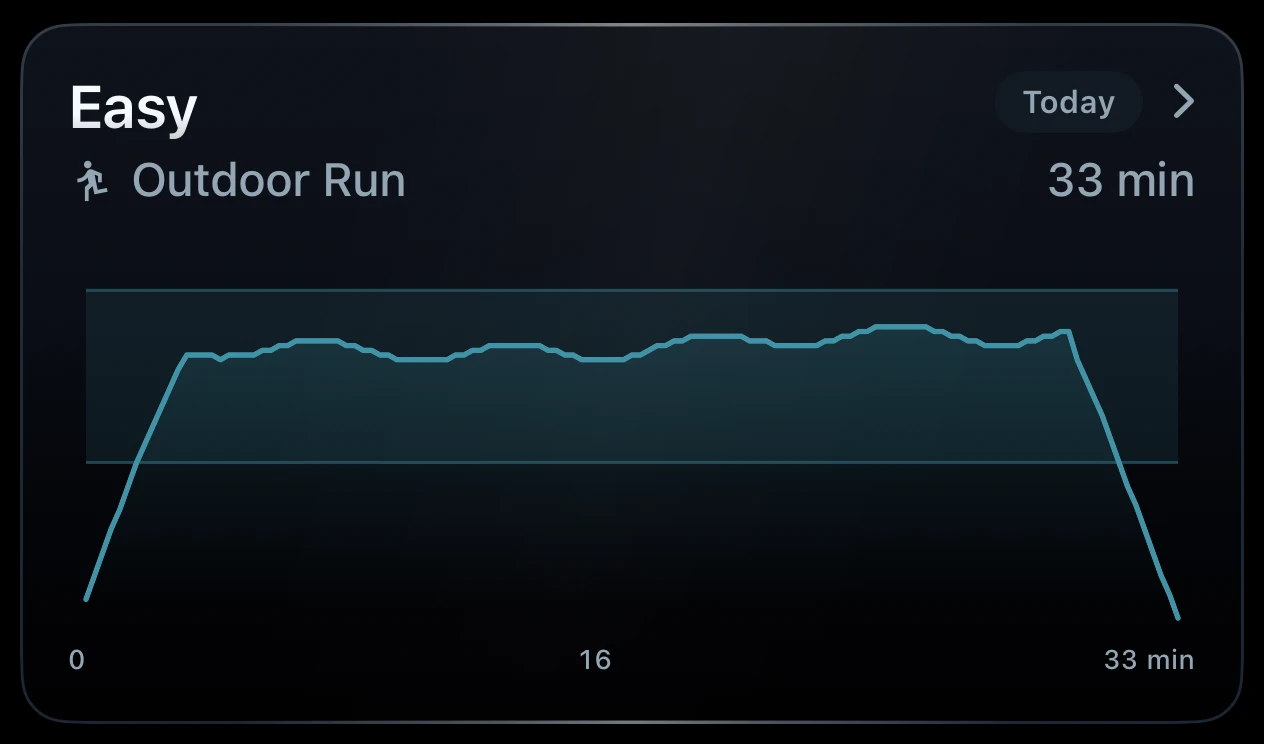
Training by heart rate works without an exact VO₂max. Your heart rate bands come from your max heart rate, and the watch reads your heart rate on every run. Type your age below to see your own bands.
Find your heart rate zones
Type your age. Add your sex and a max you have seen if you know them. The example below is a 35-year-old.
Age 35 · max heart rate 208 − 0.7 × 35 = 184, an estimate
Your Easy band, your Zone 2111 to 146beats a minute
Your Easy band runs 16 beats higher than the common Zone 2 chart lets you go.
Max from age uses Tanaka’s formula (208 − 0.7 × age). Easy ends where blood tests find lactate starting to rise, which is higher for women than for men. What you type stays on this page.
Diastra reads your max from your own Apple Watch workouts or a guided test and draws your bands from it.
Start my free trialThe Zone 2 you know is the Easy band above, and Easy builds your aerobic base. The top band shares its name with the measure on this page. That VO₂max band is for hard intervals, and the guide on how to improve VO₂max shows how a week puts the two together.
Diastra does not use the Cardio Fitness number. It reads every workout your Apple Watch saved in Apple Health. It finds your max heart rate in those workouts and draws Easy, Threshold and VO₂max from it. Over the weeks it reads your heart rate in those workouts and shows whether your training is working, even when the answer is no.
See your own bands from your own workouts.
Diastra reads every workout your Apple Watch saved, finds your real max heart rate and draws Easy, Threshold and VO₂max from it. Then it holds you in your band on every run and shows you over the weeks whether your training is working.
Start my free trial$119 a year, or $19.99 a month. Seven days free. For iPhone and Apple Watch.
More questions
Why can Cardio Fitness drop after a single run?
One estimate is one reading. Apple names heat, caffeine, a recent move to high altitude and not drinking enough as things that raise heart rate and can pull an estimate down. Carrying a heavy load or running on sand can do the same. Look at the trend across a few months of outdoor walks and runs, because one drop after a hot or hilly day says little about your fitness.
Does Apple Watch estimate VO₂max on a treadmill?
Apple says indoor workouts are left out of the estimate, and that includes workouts on gym equipment. The estimate comes from Outdoor Walk, Outdoor Run and Hiking workouts. Apple's paper adds that the watch can also make an estimate while you walk outdoors with no workout running. A runner who trains mostly on a treadmill can add some outdoor walks or runs to give the watch chances to update.
Can Apple Watch read VO₂max too high?
It can. The watch read 1.4 points higher than Apple's own reference on average. The 3 least fit people in the Series 7 study read 3.8 points high on average. The range of agreement in both Dublin studies reached about 6 points above the lab.
Is a newer Apple Watch more accurate?
None of the three outside studies tested two models on the same people. The 2025 study mixed watches from Series 5 to Series 9, SE 2 and Ultra 2, and its authors saw no trend in accuracy by model. Those watches read 6.1 points low on average, and the Series 10 study found 6.3. Apple says Series 3 and later can estimate Cardio Fitness.
Does a wrong weight in the Health app change the estimate?
It can. Apple's paper says a wrong age, sex or weight in the Health app can keep the estimates off over time. Apple's support page shows how to fix these details in the Watch app on iPhone. Tap My Watch, then Health, then Health Details.
Sources
- Apple. May 2021. Using Apple Watch to Estimate Cardio Fitness with VO2 max. Apple white paper. Read October 4, 2026.Apple built the estimate from 534 people and checked it on 221 against a VO₂max projected from the easier part of lab tests. The watch read 1.4 points high on average, and one person's estimates spread by a typical 1.2 points.
- Apple Support. Track your cardio fitness levels. Published September 14, 2026. Read October 4, 2026.The three outdoor workouts that give an estimate, the rule that leaves indoor workouts out, and the personal details the watch uses.
- Apple Support. Get the most accurate measurements using your Apple Watch. Published March 10, 2026. Read October 4, 2026.A snug fit on top of the wrist keeps the heart rate sensor close to the skin during a workout.
- Caserman P, Yum S, Göbel S, Reif A, Matura S. 2024. Assessing the Accuracy of Smartwatch-Based Estimation of Maximum Oxygen Uptake Using the Apple Watch Series 7: Validation Study. JMIR Biomed Eng 9:e59459.19 adults aged 18 to 63 did a lab test on a bike. The Series 7 averaged 41.4 against 45.9 in the lab, a typical miss of 15.8%.
- Lambe R, O'Grady B, Baldwin M, Doherty C. 2025. Investigating the accuracy of Apple Watch VO2 max measurements: A validation study. PLoS One 20(5):e0323741.28 adults wore Apple Watches from Series 5 to Series 9, SE 2 and Ultra 2. The watch read 6.1 points below a treadmill lab test on average, a typical miss of 13.3%, with no trend by model.
- Lambe R, Schumann M, Donnelly L, Hamilton S, Lally S, Rafter E, O'Reilly S, White T, Doherty C. 2026. Accuracy of VO2 max Estimates From Apple Watch Series 10. Mayo Clin Proc Digit Health 4(2):100357.35 adults with a Series 10. The watch read 6.3 points low on average and matched the lab percentile band for 5 people. In an exploratory check, the fittest group read 7.8 points low.
- Molina-Garcia P, Notbohm HL, Schumann M, et al. 2022. Validity of Estimating the Maximal Oxygen Consumption by Consumer Wearables: A Systematic Review with Meta-analysis and Expert Statement of the INTERLIVE Network. Sports Med 52(7):1577-1597.14 studies of watches from other brands, with no Apple Watch. In the 8 that estimated during exercise, the group average was off by 0.09 points and one person could be off by about 10 either way.